

May 27, 2026
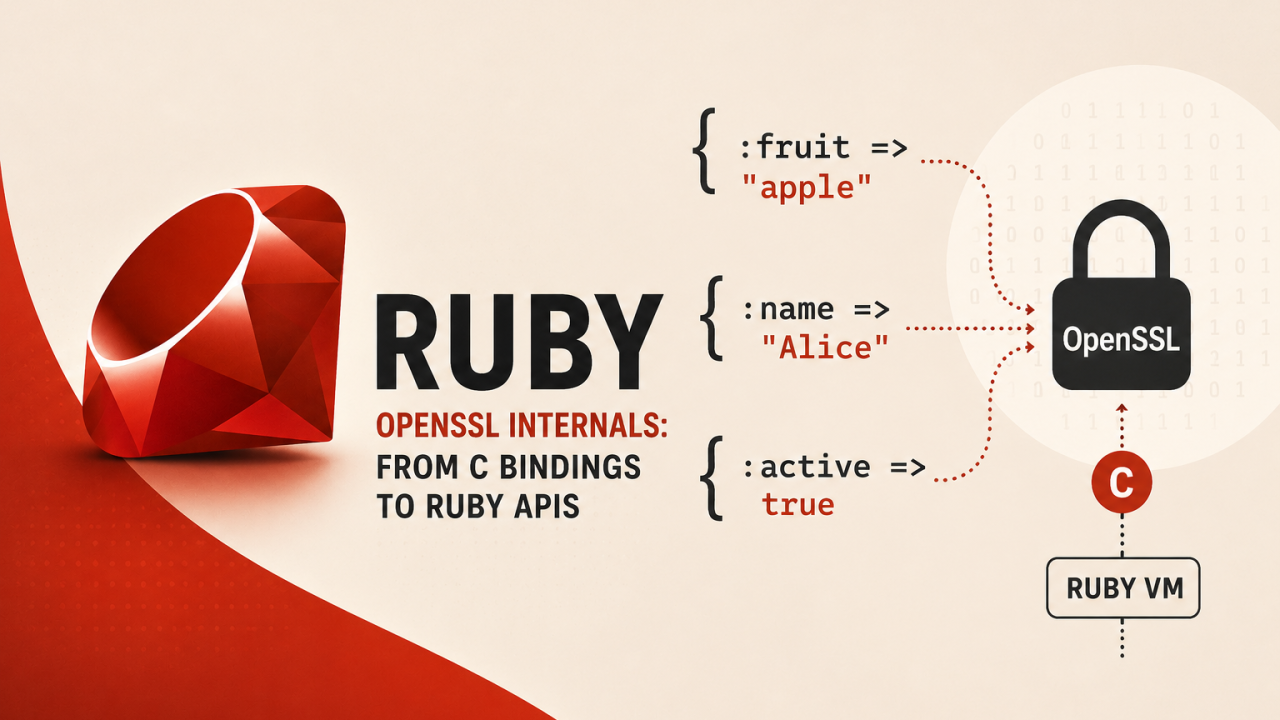
Ruby ships with a standard library gem named openssl, responsible for exposing cryptographic primitives, TLS/SSL sockets, certificates, digests, encryption, and secure communication APIs directly to Ruby developers.


Under the hood, this is not a pure Ruby implementation.
The openssl gem is primarily a C extension that bridges the Ruby VM with the native OpenSSL library written in C. Ruby wraps OpenSSL structures, functions, and memory management mechanisms into high-level Ruby classes such as:
- OpenSSL::SSL::SSLSocket
- OpenSSL::X509::Certificate
- OpenSSL::Digest
- OpenSSL::Cipher
- OpenSSL::PKey
This architecture allows Ruby applications to use battle-tested cryptographic primitives while still exposing an idiomatic Ruby API.
Inside the extension, Ruby uses its C API to define classes, allocate wrapped native structures, map OpenSSL functions into Ruby methods, and safely manage memory between the Ruby garbage collector and OpenSSL internals.
At a high level, the flow looks like this:
OpenSSL C library ↓Ruby C extension ↓Ruby stdlib APIs ↓Ruby applications
That means when a Ruby developer writes something like:
require "openssl"digest = OpenSSL::Digest::SHA256.hexdigest("ruby")
Ruby is actually delegating most of the cryptographic work to native OpenSSL functions implemented in C.
The same applies to HTTPS requests, TLS sockets, certificate validation, encrypted communication, and many authentication flows used by modern Ruby applications.
In this article, we’ll explore:
- how Ruby wraps OpenSSL internally
- the structure of the extension source code
- how native OpenSSL objects are mapped into Ruby objects
- memory management between C and Ruby
- SSL/TLS abstractions inside Ruby
- and practical examples showing how these APIs are used in real applications
The structure of Ruby’s OpenSSL extension
The extension is organized into multiple C files, each responsible for wrapping a different OpenSSL subsystem.
Some important files include:
ossl.cossl_ssl.cossl_cipher.cossl_digest.cossl_pkey.cossl_x509cert.cossl_bn.c
Each file exposes native OpenSSL functionality into Ruby classes and methods.
For example:
- ossl_digest.c wraps hashing algorithms
- ossl_cipher.c handles symmetric encryption
- ossl_ssl.c implements SSL/TLS sockets
- ossl_x509cert.c handles certificates
- ossl_pkey.c wraps public/private key APIs
Ruby initializes these modules during extension bootstrapping.
You’ll frequently find functions like:
rb_define_module("OpenSSL");rb_define_class_under(...);rb_define_method(...);
This is Ruby’s C API exposing native functionality into the Ruby object model.
How Ruby maps C structures into Ruby objects
One of the most interesting parts of the extension is how Ruby wraps native OpenSSL structures.
For example, OpenSSL internally uses structures like:
SSLSSL_CTXX509EVP_MD_CTXEVP_CIPHER_CTXRSA
Ruby cannot expose raw C pointers directly.
Instead, it wraps them into Ruby objects using TypedData structures.
A simplified conceptual example looks like this:
TypedData_Wrap_Struct(klass, &data_type, ptr);
This allows Ruby objects to hold references to native OpenSSL structures while still participating in Ruby’s garbage collection lifecycle.
Internally, Ruby associates:
Ruby object ↓Wrapped native pointer ↓OpenSSL C structure
This is the core mechanism that makes the extension work.
Memory management between Ruby and OpenSSL
Memory management becomes especially important when mixing Ruby and C.
Ruby uses garbage collection.
OpenSSL often uses manual allocation and deallocation.
That means the extension must carefully coordinate both worlds.
You’ll commonly see functions such as:
OPENSSL_malloc(...)OPENSSL_free(...)
combined with Ruby allocation hooks and cleanup callbacks.
Ruby extensions typically define:
- allocation functions
- free functions
- mark functions
- typed data descriptors
to ensure native memory is correctly released when Ruby objects are garbage collected.
Without this layer, memory leaks or segmentation faults would be extremely common.
Digest APIs: hashing through native OpenSSL
One of the easiest APIs to recognize is OpenSSL::Digest.
Ruby developers often use it like this:
require "openssl"OpenSSL::Digest::SHA256.hexdigest("hello")
Internally, Ruby maps that call into OpenSSL EVP digest APIs implemented in C.
Conceptually:
Ruby method call ↓Ruby C extension ↓EVP digest functions ↓OpenSSL hashing engine
This gives Ruby direct access to optimized native cryptographic implementations.
Symmetric encryption with OpenSSL::Cipher
Ruby also exposes encryption primitives through OpenSSL::Cipher.
Example:
require "openssl"cipher = OpenSSL::Cipher.new("aes-256-cbc")cipher.encryptkey = cipher.random_keyiv = cipher.random_ivencrypted = cipher.update("ruby internals") + cipher.final
Under the hood, the extension initializes native OpenSSL cipher contexts such as:
EVP_CIPHER_CTX
and delegates encryption operations directly to OpenSSL.
Ruby mainly acts as a high-level orchestration layer.
The heavy cryptographic work still happens in native C code.
SSL/TLS sockets inside Ruby
One of the most critical parts of the extension is SSL/TLS support.
Ruby’s HTTPS ecosystem depends heavily on:
OpenSSL::SSL::SSLSocket
This powers:
- Net::HTTP
- HTTPS connections
- API clients
- Rails integrations
- secure TCP communication
A simplified TLS flow looks like this:
Ruby app ↓OpenSSL::SSL::SSLSocket ↓Ruby OpenSSL C extension ↓OpenSSL SSL/TLS engine ↓Encrypted network traffic
This is why nearly every Ruby application indirectly depends on the OpenSSL extension.
Without it, HTTPS communication would not function.
X509 certificates and certificate parsing
Ruby also exposes certificate APIs through:
OpenSSL::X509::Certificate
Example:
pem = File.read("cert.pem")cert = OpenSSL::X509::Certificate.new(pem)puts cert.subjectputs cert.issuer
Internally, the extension parses X509 structures using native OpenSSL APIs and exposes them as Ruby objects.
This layer is essential for:
- TLS verification
- certificate chains
- HTTPS validation
- secure identity verification
Ruby as an orchestration layer over OpenSSL
One important insight when exploring the source code is that Ruby itself is not implementing cryptographic algorithms.
Instead:
- OpenSSL implements the cryptography
- Ruby wraps and orchestrates it
- Ruby exposes ergonomic APIs to developers
That distinction matters.
When developers use:
OpenSSL::DigestOpenSSL::CipherOpenSSL::SSL
they are interacting with abstractions layered on top of native OpenSSL code.
Ruby acts as the bridge between developer-friendly APIs and highly optimized C implementations.
Why this architecture matters
This design gives Ruby several advantages:
- access to mature cryptographic implementations
- compatibility with industry TLS standards
- high performance native operations
- portability across platforms
- reusable security infrastructure
At the same time, it introduces challenges:
- compatibility with OpenSSL versions
- native extension maintenance
- memory management complexity
- platform-specific behavior
- ABI changes between OpenSSL releases
This became especially visible during the migration from OpenSSL 1.1 to OpenSSL 3.x.
Many gems and Ruby environments experienced compatibility issues because native bindings had to adapt to upstream API changes.
Real-world impact across the Ruby ecosystem
The OpenSSL extension is deeply integrated into the Ruby ecosystem.
It powers:
- HTTPS requests
- Rails encrypted credentials
- authentication flows
- API clients
- OAuth integrations
- secure cookies
- TLS web servers
- certificate validation
Even tools such as:
BundlerRubyGemsNet::HTTPFaradayPumaOpenURI
depend on OpenSSL functionality.
In practice, most Ruby developers use the extension every day, even without directly requiring openssl.
Final thoughts
Ruby’s OpenSSL stdlib is a great example of how the Ruby ecosystem bridges high-level developer ergonomics with low-level native systems programming.
Behind a simple Ruby API lies:
- native OpenSSL structures
- C extensions
- VM integration
- typed data wrappers
- memory management hooks
- SSL/TLS engines
- cryptographic primitives
Understanding this architecture helps explain how Ruby interacts with native libraries, how C extensions work internally, and why OpenSSL remains one of the most important components in the Ruby ecosystem.
More importantly, it shows that many Ruby abstractions are carefully layered systems built on top of powerful native foundations.