

May 26, 2026
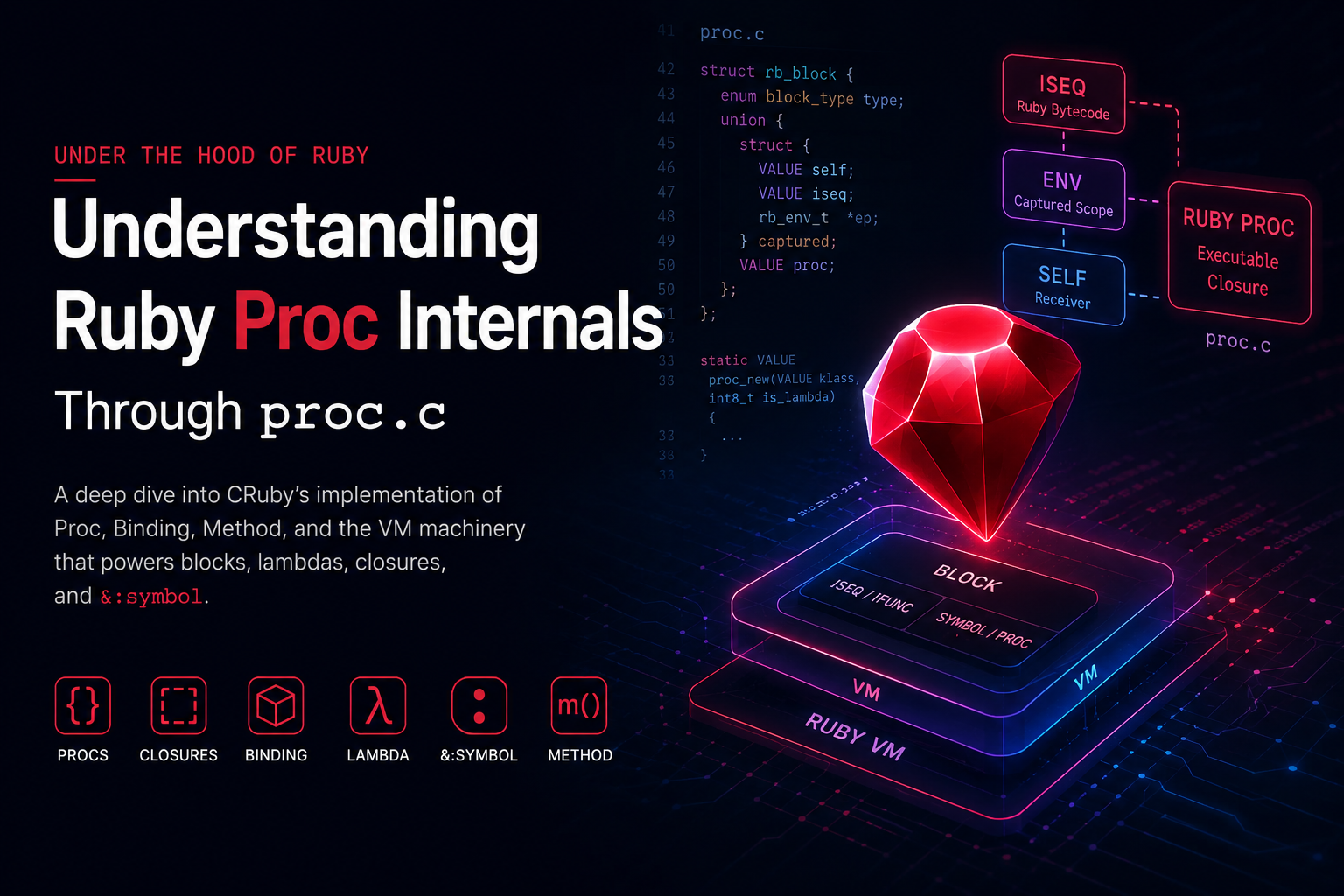
Ruby’s elegance hides an extremely sophisticated runtime underneath. Features like blocks, lambdas, closures, binding, method(:foo), and even &:to_s rely on a dense set of VM internals implemented in CRuby’s proc.c.
This file is one of the best entry points for understanding how Ruby models executable code objects.
The source analyzed here comes from CRuby’s implementation file:
proc.c
It implements:
- Proc
- Binding
- Method
- closures
- lexical environments
- lambda semantics
- block invocation
- symbol-to-proc conversion
- VM execution plumbing
For anyone working with:
- metaprogramming
- schedulers
- async runtimes
- fibers
- DSLs
- JIT internals
- Ruby performance
- advanced Rails abstractions
this file is extremely valuable.


Proc Objects Are VM-Level Executable Closures
At the Ruby level:
pr = proc { |x| x * 2 }pr.call(10)# => 20
Internally, CRuby models this as a captured execution block with:
- instruction sequence (iseq)
- execution environment (ep)
- receiver (self)
- metadata about lambda semantics
The central runtime structure is:
struct rb_block
The runtime distinguishes several kinds of executable blocks:
block_type_iseqblock_type_ifuncblock_type_symbolblock_type_proc
These correspond to:
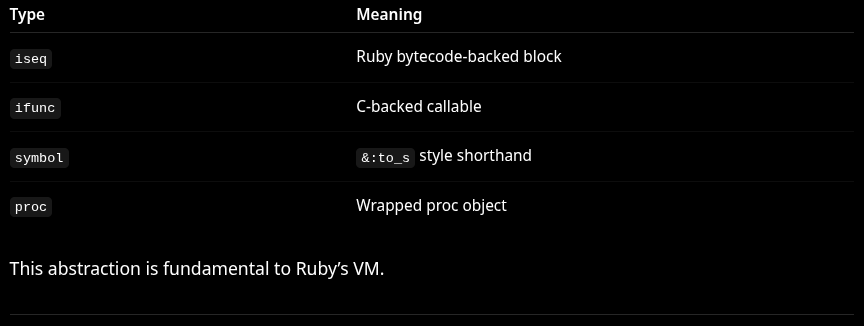
This abstraction is fundamental to Ruby’s VM.
Proc Creation
One of the most important functions in the file is:
static VALUEproc_new(VALUE klass, int8_t is_lambda)
This is the actual implementation behind:
proc {}Proc.new {}lambda {}
The VM first retrieves the current block handler:
block_handler = rb_vm_frame_block_handler(cfp)
Then converts it into a Proc.
Depending on block type:
switch (vm_block_handler_type(block_handler))
Ruby decides how the executable object should behave.
This is one of the clearest places to see that Ruby blocks are not merely syntax — they are VM entities attached to stack frames and execution contexts.
Lambdas vs Proc: The Runtime Difference
Ruby developers know this behavior:
proc { |a,b| [a,b] }.call(1)# => [1, nil]lambda { |a,b| [a,b] }.call(1)# => ArgumentError
Inside proc.c, the distinction is explicit:
proc->is_lambda
The runtime changes:
- arity validation
- argument coercion
- return
- break
- block semantics
The implementation:
VALUErb_proc_lambda_p(VALUE procval)
simply exposes the VM flag to Ruby.
This small boolean changes major runtime semantics.
Arity Calculation Is Surprisingly Complex
This section is particularly educational:
rb_proc_arity(VALUE self)
Ruby must calculate:
- required args
- optional args
- splats
- keyword args
- forwarding args
- lambda strictness
The VM computes min/max ranges:
rb_vm_block_min_max_arity
This explains why Ruby can report:
proc { |a,*b| }.arity# => -2
Negative arity means:
- variable argument count
- minimum required arguments encoded as -(n+1)
This behavior is deeply tied to Ruby’s flexible parameter system.
Closures: Capturing Execution Environments
One of the most important concepts in Ruby internals is closure capture.
Ruby closures preserve:
- local variables
- surrounding scope
- execution environment
This happens through environment pointers:
captured->ep
and environment structures:
rb_env_t
The function:
get_local_variable_ptr
walks lexical environments searching for variables.
This is the mechanism enabling:
def counter n = 0 proc { n += 1 }end
The variable n survives after the method exits because the VM promotes the environment into a heap-managed closure context.
This is one of Ruby’s most powerful runtime capabilities.
Binding: Runtime Scope Objects
Ruby’s binding is effectively a serialized execution scope.
Example:
x = 10b = bindingb.eval("x * 2")# => 20
Internally:
rb_binding_new()
captures:
- current frame
- locals
- self
- path
- line number
The runtime stores:
- lexical scope
- execution context
- local variable tables
This is why binding is incredibly powerful — and expensive.
Symbol#to_proc and the Famous &:method
One of Ruby’s most iconic idioms:
users.map(&:name)
is implemented through:
rb_sym_to_proc
Ruby converts:
:name
into a cached proc object.
The file even contains a proc cache:
sym_proc_cache
to avoid repeated allocations.
This is a great example of:
- syntactic sugar
- runtime optimization
- object caching
all interacting together.
Method Objects Are First-Class Runtime Structures
Ruby methods can become objects:
m = method(:puts)
Internally:
struct METHOD
stores:
- receiver
- owner
- method entry
- class
- iclass
- dispatch metadata
This powers:
method(:foo).callmethod(:foo).to_proc
Ruby treats methods as fully reified runtime entities.
That design is a huge reason why Ruby metaprogramming feels so natural.
VM Invocation
Eventually, all proc execution funnels into:
rb_vm_invoke_proc
This is where the VM:
- validates arguments
- prepares frames
- handles keyword splats
- manages block handlers
- invokes bytecode or C-backed callables
This function is one of the bridges between:
- Ruby syntax
- VM execution
- call stack mechanics
Understanding this layer helps explain:
- block overhead
- Fiber interaction
- scheduler behavior
- async runtimes
- tracing systems
Why This Matters for Modern Ruby
This file also includes:
#include "ractor_core.h"#include "yjit.h"
meaning these concepts interact directly with:
- Ractors
- YJIT
- concurrency
- execution isolation
- optimization pipelines
Modern Ruby performance work heavily depends on understanding:
- captured environments
- block invocation
- lambda semantics
- frame allocation
- Proc creation costs
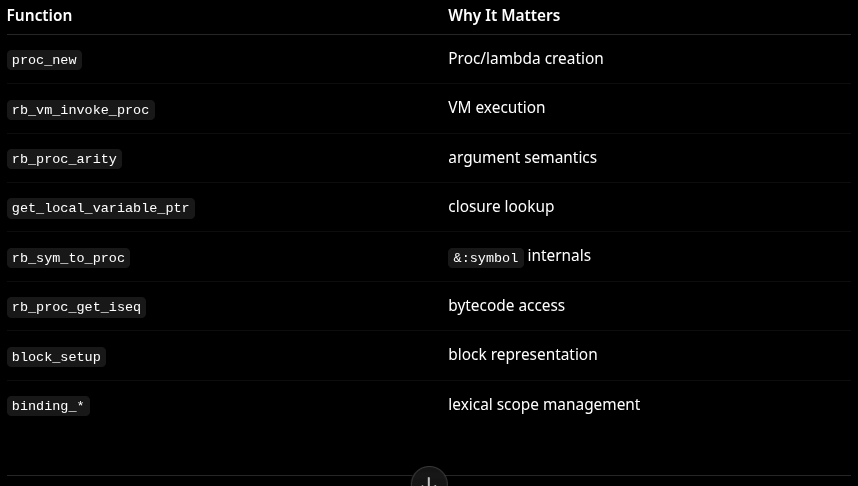
The Most Valuable Sections to Study
If you want to explore Ruby internals deeply, focus on:
Final Thoughts
proc.c demonstrates that Ruby’s high-level elegance is built on a carefully engineered VM architecture.
Features developers use casually every day:
- blocks
- lambdas
- closures
- bindings
- method objects
- &:symbol
are implemented through:
- execution frames
- environment pointers
- bytecode metadata
- block handlers
- VM dispatch systems
Studying this file changes how you see Ruby.
Blocks stop being “just syntax” and become what they really are:
heap-managed executable closures tied to lexical environments and VM execution frames.