
June 8, 2026
As developers, we often chase the big topics.
Distributed systems.
Microservices.
Event-driven architectures.
AI.
Scalability.
Performance.
The industry constantly presents us with bigger mountains to climb.
In that pursuit, we sometimes walk past the things we use every single day.
The familiar.
The routine.
The pieces that quietly do their job without asking for attention.
One of those pieces is the Ruby on Rails request–response cycle.
Every page we render.
Every API endpoint we expose.
Every button a user clicks.
Every request follows the same journey.
Most of us know the destination.
Fewer of us stop to appreciate the path.
Today, I’d like to explore that path through a different lens.
Not as a pipeline.
Not as a stack.
But as a shared echo.
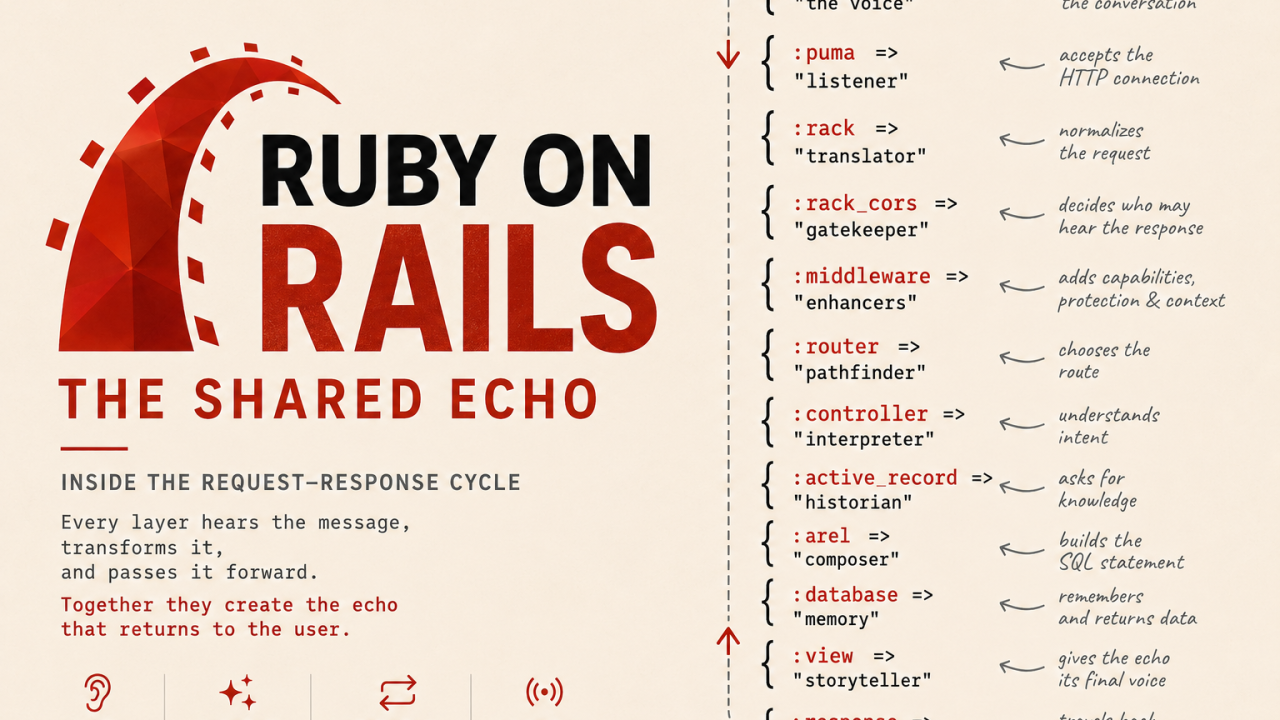
The Shared Echo
Imagine standing at the edge of a canyon.
You speak.
Your voice travels forward.
It touches the landscape.
The rocks shape it.
The distance changes it.
The air transforms it.
When the sound returns, it is no longer exactly what you said.
It is an echo.
A reflection of your original voice shaped by everything it encountered along the way.
A Rails request works much the same way.
The user sends a message.
The application listens.
Each layer hears that message, transforms it, and passes it forward.
When the response finally returns to the browser, it carries the fingerprints of every layer that participated in its creation.
No single component owns the response.
Together, they create the echo.

The First Voice: The Browser
Every echo begins with a voice.
In web applications, that voice belongs to the browser.
A user clicks a button.
Submits a form.
Requests a page.
Calls an API.
The browser turns that intention into an HTTP request and sends it into the world.
The conversation has begun.
Puma: The Listener
The first Rails component to hear the message is Puma.
Puma listens for incoming connections and accepts the request.
Like someone hearing a voice from across the canyon, Puma’s job is simple:
Listen.
Receive.
Pass it along.
It does not decide what the message means.
It simply ensures the conversation can begin.
Rack: The Translator
Every participant in a conversation needs a common language.
That is Rack’s responsibility.
Rack transforms the raw HTTP request into a standard interface that every Ruby web framework understands.
Without Rack, each framework would speak a different dialect.
Rack gives them a shared vocabulary.
The voice becomes understandable.
Rack::Cors: The Gatekeeper
Not every echo should be heard by everyone.
Before the request continues, Rack::Cors may step in.
Its responsibility is not to create the response.
Its responsibility is to decide who may receive it.
When browsers enforce Cross-Origin Resource Sharing policies, Rack::Cors provides the headers that determine whether the conversation is allowed to continue.
The gatekeeper does not change the message.
It decides who may hear it.
Middleware: The Travelers Along the Path
Rails applications often include middleware that enriches the journey.
Authentication.
Logging.
Session management.
Caching.
Security protections.
Each middleware hears the message and leaves a small trace before passing it forward.
Most are invisible during normal operation.
Yet every request passes through them.
Quiet participants in the shared echo.
The Router: The Pathfinder
A message without direction quickly gets lost.
The router examines the request and determines where it should go.
Which controller?
Which action?
Which path?
The router is the guide standing at the crossroads.
It does not answer questions.
It simply knows where answers can be found.
The Controller: The Interpreter
The controller is where intent becomes action.
What does the user want?
Which business rules apply?
Which information must be retrieved?
The controller interprets the request and orchestrates the next steps.
It understands the question.
But it does not yet possess the answer.
Active Record: The Historian
The controller turns to Active Record.
Active Record knows where knowledge lives.
It knows how to ask for users, orders, products, invoices, and relationships.
It acts as the historian of the application.
Searching through memory to find what the conversation requires.
Arel: The Composer
Many Rails developers use Arel every day without realizing it.
When we write:
User.where(active: true)
We are not writing SQL.
We are expressing intent.
Arel takes that intent and composes it into a structured query.
Like a composer translating ideas into sheet music, Arel transforms Ruby expressions into SQL that the database can understand.
The Database: Memory
Eventually, the message reaches the deepest point of the canyon.
The database.
This is where memory resides.
The database remembers.
It stores facts.
Relationships.
History.
The answer to the user’s question often lives here.
The database returns its knowledge, and the journey begins again.
The View: The Storyteller
Many diagrams stop at the database.
Rails does not.
Raw data is not yet a response.
Someone must shape the answer.
Someone must tell the story.
That responsibility belongs to the View.
Whether generating HTML, JSON, XML, or another format, the View transforms information into something meaningful for the recipient.
The storyteller gives the echo its final voice.
The Return of the Echo
The response now begins its return journey.
Back through controllers.
Back through middleware.
Back through Rack.
Back through Puma.
Back to the browser.
The user receives what appears to be a simple response.
A page.
A JSON document.
A status code.
But that response is more than data.
It is a shared echo.
Created collectively by every layer that participated in the conversation.
Why This Matters
Understanding the request–response cycle is not just an academic exercise.
It helps us answer practical questions:
Why is this page slow?
Where should I add caching?
Why is CORS failing?
Which middleware is modifying the request?
Why is this query expensive?
Where should this logic live?
The more clearly we understand the journey, the more effectively we can debug, optimize, and design our applications.
Final Thoughts
The most important parts of our systems are not always the newest.
Sometimes they are the things we use so often that they become invisible.
The request–response cycle is one of those things.
A familiar path.
A daily routine.
A journey we rarely stop to admire.
Yet every request that enters a Rails application depends on it.
Every response that reaches a user is shaped by it.
Every layer hears the message.
Every layer changes it.
Every layer passes it forward.
And together, they create the shared echo.