

June 1, 2026
Introduction
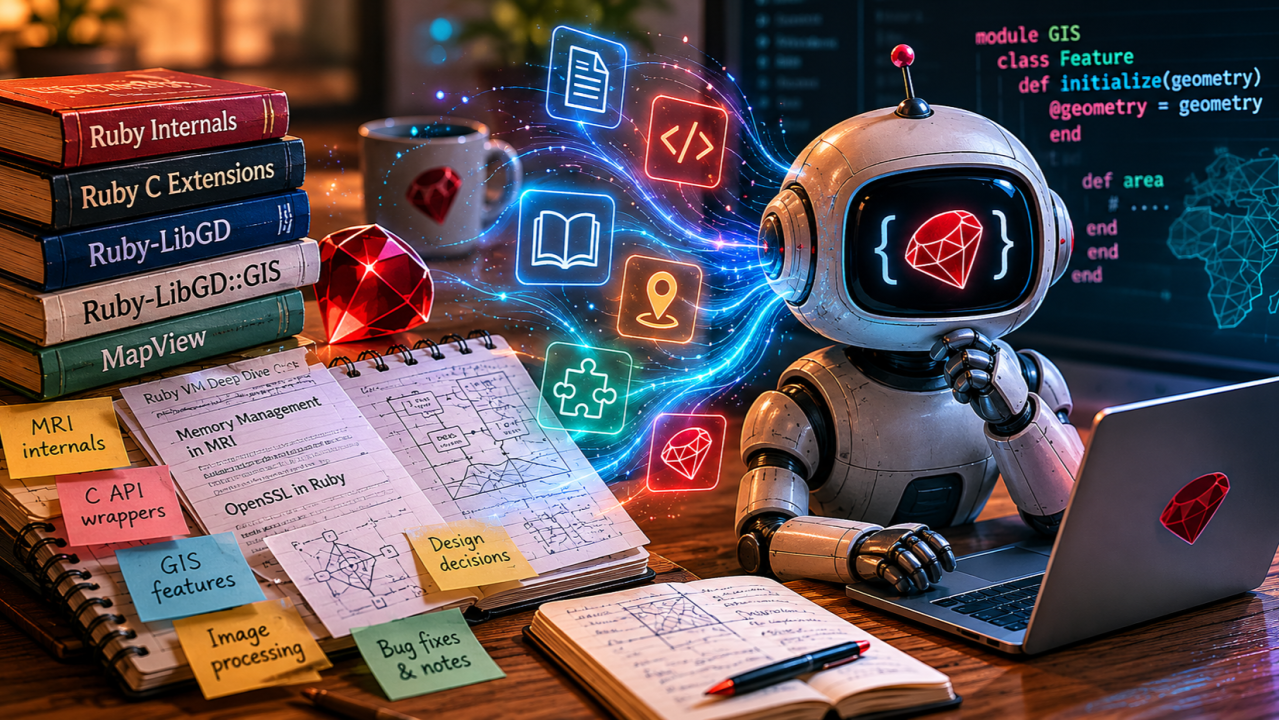
Over the years, most Ruby developers accumulate a vast amount of knowledge.
Not just source code, but articles, documentation, experiments, bug fixes, pull requests, design decisions, and lessons learned from maintaining production systems.
The problem is that this knowledge often remains scattered across repositories, blogs, notes, and forgotten directories. Even when the information exists, finding the right piece of knowledge at the right time can be surprisingly difficult.
Recent advances in local AI models have created an interesting opportunity: what if we could turn years of accumulated Ruby expertise into a coding assistant that understands our tools, libraries, and development practices?
This article explores that idea.


The Knowledge Gap
Modern language models generally understand Ruby reasonably well. They can explain blocks, classes, modules, metaprogramming, and common Rails patterns.
However, they know very little about:
- Custom gems
- Internal company libraries
- Specialized Ruby ecosystems
- Private codebases
- Years of project-specific experience
For example, asking a model how to expose a GIS structure through a Ruby C extension may produce a generic answer. The model understands Ruby and C, but it does not understand the conventions, architecture, and design decisions that evolved within a specific project.
The missing piece is context.
A Hidden Asset
Many developers already possess a valuable knowledge base without realizing it.
In my case, that knowledge includes:
- Ruby internals articles
- Notes about the Ruby VM
- OpenSSL implementation details
- Ruby C extension examples
- Image processing libraries
- GIS-related Ruby projects
- Years of development experience captured in code and documentation
The challenge was not creating new knowledge.
The challenge was making existing knowledge accessible.
Three Approaches
1. Prompt Engineering
The simplest approach is creating a custom model profile:
You are an expert in Ruby, Ruby C Extensions, GIS, and image processing.
This helps guide responses but does not teach the model anything new.
The model behaves differently, but its knowledge remains unchanged.
2. Supplying Project Context
Tools such as Aider can provide source files directly to the model.
When the model can read the actual codebase, the quality of its responses improves significantly. Instead of guessing how a library works, it can inspect the implementation.
For many Ruby projects, this alone provides substantial value.
3. Retrieval-Augmented Generation (RAG)
The most interesting approach is retrieval.
Before generating a response, the system searches through:
- Articles
- Documentation
- Examples
- Source code
- Project notes
Relevant information is added to the prompt, allowing the model to answer using the developer’s own accumulated knowledge.
Instead of relying solely on training data, the assistant becomes a gateway to years of technical experience.
Building a Ruby Knowledge Base
A simple structure can be surprisingly effective:
ruby-knowledge/├── articles/├── docs/├── examples/├── gems/└── notes/
Every article, code sample, and piece of documentation becomes part of a searchable technical memory.
Over time, the assistant becomes increasingly useful because its knowledge grows alongside the developer’s work.
What Surprised Me
The biggest surprise was that training a model was not the first step.
The real challenge was organizing information.
Articles written years ago suddenly became valuable again. Old examples turned into reusable knowledge. Documentation that had been forgotten became discoverable.
The process revealed that the most important asset was not the model itself.
It was the accumulated knowledge behind it.
Conclusion
Developers spend years building expertise, but much of that expertise remains trapped in repositories, blogs, and personal notes.
Local AI tools offer an opportunity to unlock that knowledge and make it reusable.
Rather than replacing experience, these systems can amplify it.
The result is not a general-purpose AI assistant.
The result is something far more interesting: a coding assistant that learns from your own journey as a Ruby developer.

 Linking Ruby knowledge from the most remote places in the world.