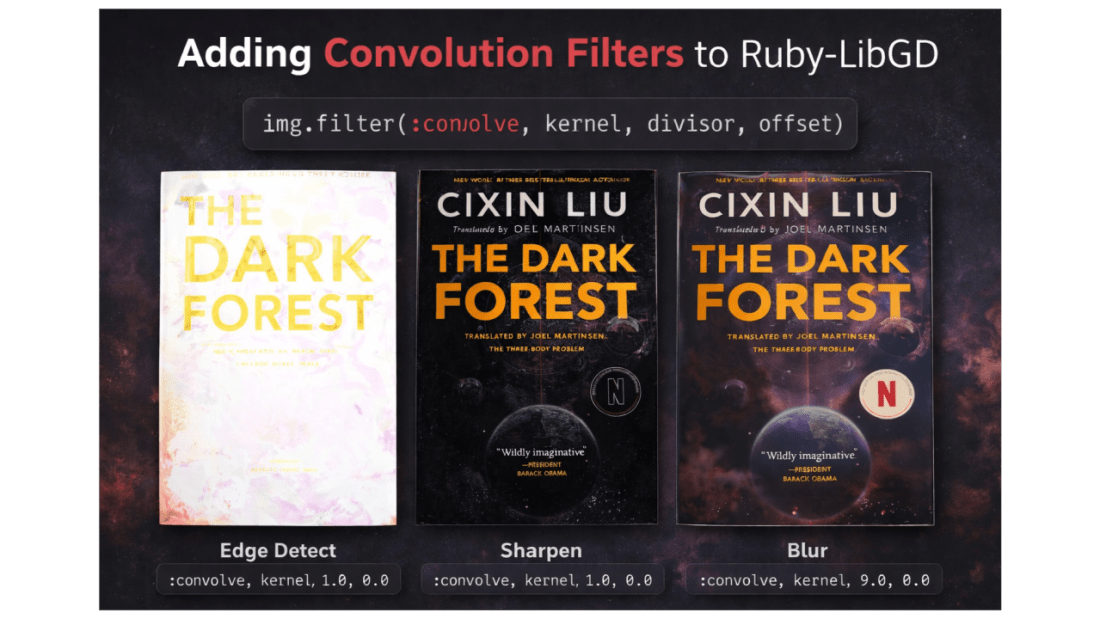
Understanding Convolution Filters in Image Processing (and Adding Them to Ruby-LibGD v0.2.5)

Understanding Convolution Filters in Image Processing (and Adding Them to Ruby-LibGD v0.2.5) March 3, 2026 Today I implemented support for custom convolution filters in Ruby-LibGD, enabling the application of kernels such as blur, sharpen, and edge detection directly from Ruby. At first glance, this may look like just another image filter. In reality, convolution is … Continue reading Understanding Convolution Filters in Image Processing (and Adding Them to Ruby-LibGD v0.2.5)
πŸš€ The Production-Grade Ruby Microservices Stack (2026)

The Production-Grade Ruby Microservices Stack (2026) March 2, 2026 Microservices don’t fail because of Ruby. They fail because of architecture. Most β€œmicroservices” I see in Ruby are: β€’ HTTP chains tightly coupled together β€’ Shared databases behind the scenes β€’ No tracing β€’ No event replay β€’ No contract validation That’s not distributed architecture. That’s … Continue reading πŸš€ The Production-Grade Ruby Microservices Stack (2026)

πŸ‡―πŸ‡΅ Kaigi 2026 Is Approaching β€” Why the Global Ruby Community Should Pay Close Attention

Kaigi 2026 Is Approaching β€” Why the Global Ruby Community Should Pay Close Attention March 2, 2026 With April approaching, RubyKaigi 2026 is about to take place in Hakodate, Japan β€” and for the global Ruby community, this is not just another date on the calendar. It is a moment that often defines the technological … Continue reading πŸ‡―πŸ‡΅ Kaigi 2026 Is Approaching β€” Why the Global Ruby Community Should Pay Close Attention

πŸš€ Terminal UX in Ruby: Beautiful Tools Without Leaving the Shell

March 1, 2026 The Modern CLI Stack Beyond puts Ruby is often associated with web applications, background jobs, and scripting. But quietly β€” almost underground β€” a rich ecosystem has emerged for building modern, interactive, polished terminal applications. Not the old β€œprint some text and parse ARGV” style. We’re talking about tools that feel closer … Continue reading πŸš€ Terminal UX in Ruby: Beautiful Tools Without Leaving the Shell

🧱 Rack Is Still Innovating: The Backbone of Ruby’s Web Stack Keeps Evolving

Rack Is Still Innovating: The Backbone of Ruby’s Web Stack Keeps Evolving February 26, 2026 In recent months, much of the conversation in the Ruby ecosystem has focused on Ruby 4, Rails 8, concurrency, JIT compilers, and runtime capabilities. But while attention was on the language and frameworks, one critical component β€” present in every … Continue reading 🧱 Rack Is Still Innovating: The Backbone of Ruby’s Web Stack Keeps Evolving

Ruby 4 & Rails 8: A Multi-Front Acceleration of the Ruby Ecosystem

February 26, 2026 In recent years, Ruby and Ruby on Rails have quietly entered a phase of rapid, multidimensional evolution. Rather than a single disruptive change, what we are witnessing is a coordinated advance across the runtime, the framework, infrastructure tooling, and application capabilities. This shift has been especially visible in talks from RubyKaigi 2024–2026 … Continue reading Ruby 4 & Rails 8: A Multi-Front Acceleration of the Ruby Ecosystem

🧩 Ruby 4’s Quiet Improvements: Small Changes That Matter in Real Code

When Ruby 4 was announced, most discussions focused on experimental features like Ractors, new JIT work, or isolation mechanisms. However, beneath the headline features lies a set of quieter improvements β€” refinements to the core language and standard library that directly affect everyday development. These changes may not generate conference talks, but they improve performance, … Continue reading 🧩 Ruby 4’s Quiet Improvements: Small Changes That Matter in Real Code

🧡 Ruby 4 Concurrency Gets Real: Understanding Ractor::Port in Practice

Ruby has long balanced developer happiness with safety, but parallel performance has historically been constrained by the Global VM Lock (GVL). Ractors β€” introduced in Ruby 3 β€” were the first serious attempt to bring true multicore parallelism to MRI without sacrificing thread safety. With Ruby 4, the introduction of Ractor::Port significantly improves how Ractors … Continue reading 🧡 Ruby 4 Concurrency Gets Real: Understanding Ractor::Port in Practice

πŸ§ͺ Ruby in the Browser? Exploring Rubox and the Future of Ruby WASM

February 22, 2026 A fully client-side Ruby playground powered by WebAssembly β€” promising, experimental, and not quite ready for prime time Running Ruby directly inside the browser has long been a dream for educators, tooling developers, and the Ruby core community. Thanks to WebAssembly (WASM), that vision is no longer theoretical. Rubox, a browser-based Ruby … Continue reading πŸ§ͺ Ruby in the Browser? Exploring Rubox and the Future of Ruby WASM

🧠 RubyKaigi 2024: A Deep Technical Shift in Ruby’s Standard Library (With Real Examples)

February 20, 2026 RubyKaigi 2024 β€” Historical ContextAlthough this presentation discusses Ruby 3.4–3.5 and the ecosystem has already moved forward to Ruby 4 by 2026, the strategic shift it describes β€” reducing the traditional standard library and externalizing functionality as gems β€” represents a fundamental change in Ruby’s philosophy rather than a version-specific roadmap.Understanding this … Continue reading 🧠 RubyKaigi 2024: A Deep Technical Shift in Ruby’s Standard Library (With Real Examples)