Rack Is Still Innovating: The Backbone of Ruby’s Web Stack Keeps Evolving February 26, 2026 In recent months, much of the conversation in the Ruby ecosystem has focused on Ruby 4, Rails 8, concurrency, JIT compilers, and runtime capabilities. But while attention was on the language and frameworks, one critical component — present in every … Continue reading 🧱 Rack Is Still Innovating: The Backbone of Ruby’s Web Stack Keeps Evolving
Author: ggerman
Ruby 4 & Rails 8: A Multi-Front Acceleration of the Ruby Ecosystem
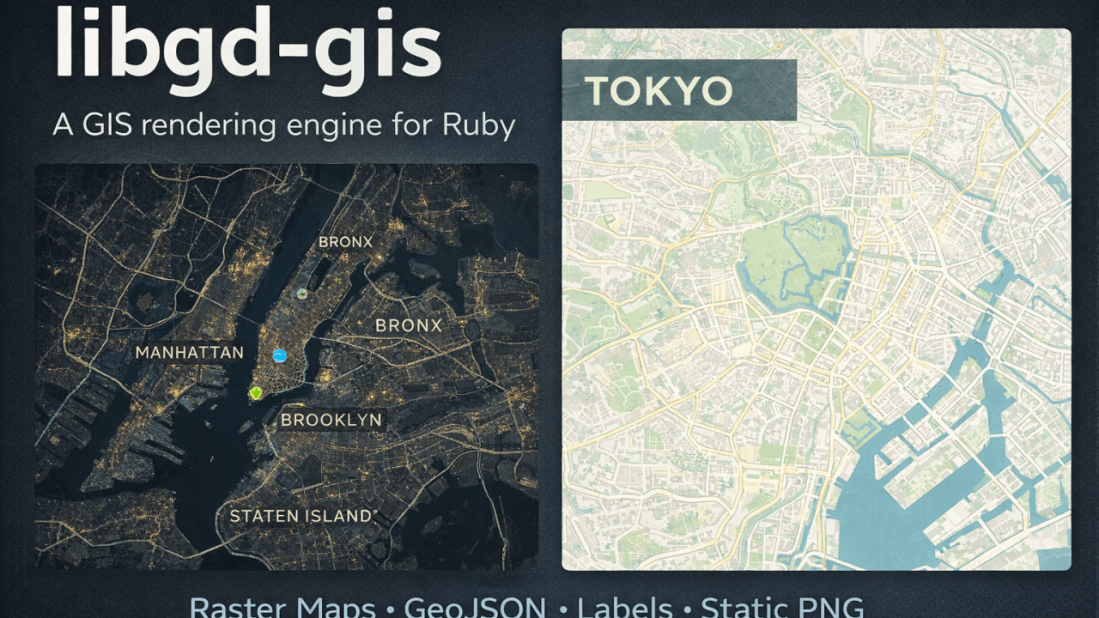
February 26, 2026 Scan to try 🎯 Live Demo Available Introducing MapView Render beautiful, production-ready maps directly from your Ruby backend. No external APIs. No dependencies. Just pure speed and control. ✓ Zero external dependencies ✓ Lightning-fast rendering ✓ Production-ready & battle-tested Try the Live Demo → Read Docs In recent years, Ruby and Ruby … Continue reading Ruby 4 & Rails 8: A Multi-Front Acceleration of the Ruby Ecosystem
🧩 Ruby 4’s Quiet Improvements: Small Changes That Matter in Real Code
When Ruby 4 was announced, most discussions focused on experimental features like Ractors, new JIT work, or isolation mechanisms. However, beneath the headline features lies a set of quieter improvements — refinements to the core language and standard library that directly affect everyday development. These changes may not generate conference talks, but they improve performance, … Continue reading 🧩 Ruby 4’s Quiet Improvements: Small Changes That Matter in Real Code
🧵 Ruby 4 Concurrency Gets Real: Understanding Ractor::Port in Practice
Scan to try 🎯 Live Demo Available Introducing MapView Render beautiful, production-ready maps directly from your Ruby backend. No external APIs. No dependencies. Just pure speed and control. ✓ Zero external dependencies ✓ Lightning-fast rendering ✓ Production-ready & battle-tested Try the Live Demo → Read Docs Ruby has long balanced developer happiness with safety, but … Continue reading 🧵 Ruby 4 Concurrency Gets Real: Understanding Ractor::Port in Practice
🧠 Pluggable Garbage Collectors in Ruby: Exploring the New Modular GC API
February 23, 2026 Ruby has traditionally shipped with a single, built-in garbage collector tightly coupled to the VM. With Ruby 3.4, that assumption begins to change. Feature #20470 introduces an experimental Modular Garbage Collector API, allowing CRuby to load alternative GC implementations at runtime. This marks one of the most significant architectural shifts in Ruby’s … Continue reading 🧠 Pluggable Garbage Collectors in Ruby: Exploring the New Modular GC API
Neither Too Much nor Too Little: A “Touch Base” on the Current State of AI
Neither Too Much nor Too Little: A “Touch Base” on the Current State of AI February 23, 2026 Motivated by the many comments — some fearful, others excessively enthusiastic — about artificial intelligence, I set out to “touch base”: to ground the discussion with a personal perspective on this tool which, no matter how useful … Continue reading Neither Too Much nor Too Little: A “Touch Base” on the Current State of AI
🧪 Ruby in the Browser? Exploring Rubox and the Future of Ruby WASM
February 22, 2026 Scan to try 🎯 Live Demo Available Introducing MapView Render beautiful, production-ready maps directly from your Ruby backend. No external APIs. No dependencies. Just pure speed and control. ✓ Zero external dependencies ✓ Lightning-fast rendering ✓ Production-ready & battle-tested Try the Live Demo → Read Docs A fully client-side Ruby playground powered … Continue reading 🧪 Ruby in the Browser? Exploring Rubox and the Future of Ruby WASM
🌍 Rendering Maps by Name: Symbolic Geographic Extents in Ruby
Working with maps usually means working with numbers — lots of numbers. If you want to render a map of a country, region, or continent, you normally need to know its exact bounding box: bbox = [-73.6, -55.1, -53.6, -21.7] # Argentina Not exactly readable. Not memorable. Not friendly. What if you could just say: … Continue reading 🌍 Rendering Maps by Name: Symbolic Geographic Extents in Ruby
🧠 RubyKaigi 2024: A Deep Technical Shift in Ruby’s Standard Library (With Real Examples)
February 20, 2026 RubyKaigi 2024 — Historical ContextAlthough this presentation discusses Ruby 3.4–3.5 and the ecosystem has already moved forward to Ruby 4 by 2026, the strategic shift it describes — reducing the traditional standard library and externalizing functionality as gems — represents a fundamental change in Ruby’s philosophy rather than a version-specific roadmap.Understanding this … Continue reading 🧠 RubyKaigi 2024: A Deep Technical Shift in Ruby’s Standard Library (With Real Examples)
What Rails Actually Wants: Tidying Controllers and Views Without Service Object Explosion
February 20, 2026 Lessons from RailsTokyo 2026 on using ActiveRecord as a relational engine—not just an ORM Modern Rails teams often inherit a paradox: controllers must be “thin,” views must be “dumb,” models must be “fat,” and yet production apps accumulate service objects, query objects, presenters, decorators, serializers, policies, and helpers until the architecture resembles … Continue reading What Rails Actually Wants: Tidying Controllers and Views Without Service Object Explosion