Ruby as an Orchestrator Language

Ruby as an Orchestrator Language March 5, 2026 Ruby excels at structuring applications, managing logic, and coordinating systems. In many real-world architectures, Ruby acts as the orchestrator, while specialized libraries handle computationally intensive tasks. This hybrid model is used widely in the Ruby ecosystem. Examples include: image processing database engines cryptography machine learning bindings GIS … Continue reading Ruby as an Orchestrator Language

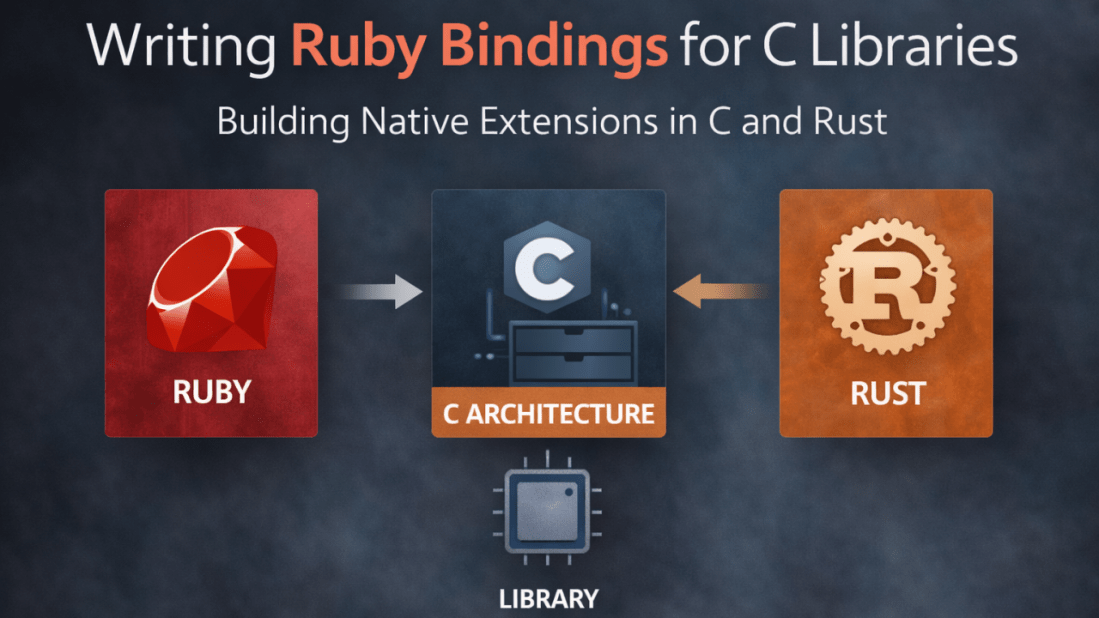
Writing Ruby Bindings for C Libraries

Writing Ruby Bindings for C Libraries March 4, 2026 Building Native Extensions with C (and Rust) Ruby is known for its productivity and elegant syntax, but sometimes performance-critical tasks require lower-level languages. Fortunately, Ruby provides a powerful mechanism called C extensions, allowing Ruby code to call native C functions directly. This approach enables Ruby developers … Continue reading Writing Ruby Bindings for C Libraries

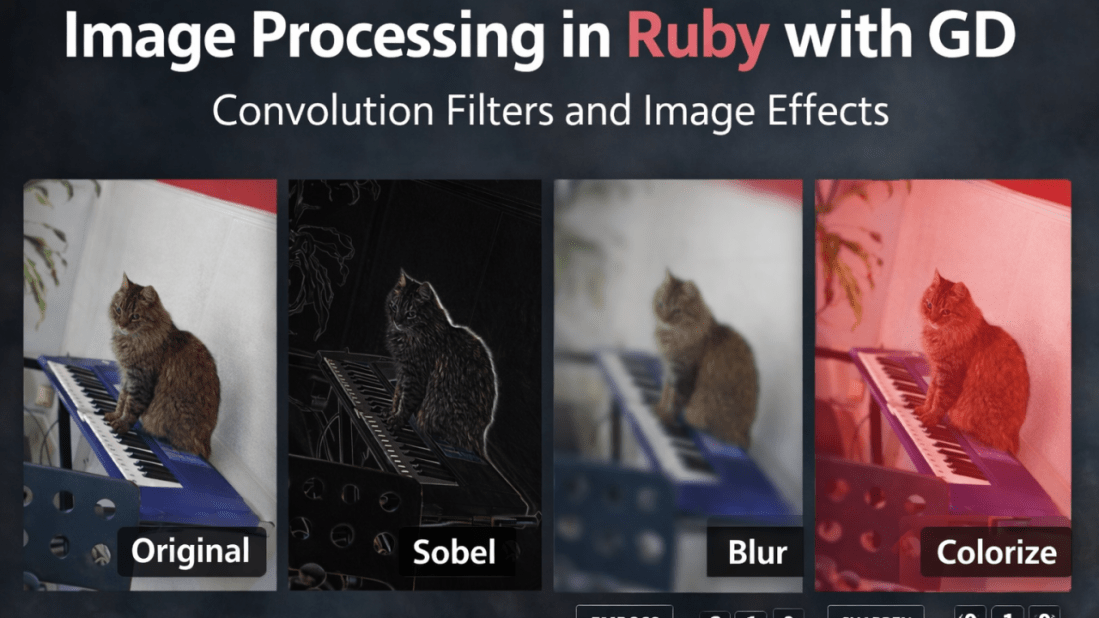
Image Processing in Ruby with GD: Exploring ruby-libgd v0.3.0

Image Processing in Ruby with GD: Exploring ruby-libgd v0.3.0 March 4, 2026 Image processing is usually associated with languages like Python or C++, but Ruby can also manipulate images efficiently thanks to bindings for native libraries. One of those libraries is libgd, a well-known C library used to dynamically generate and manipulate images such as … Continue reading Image Processing in Ruby with GD: Exploring ruby-libgd v0.3.0

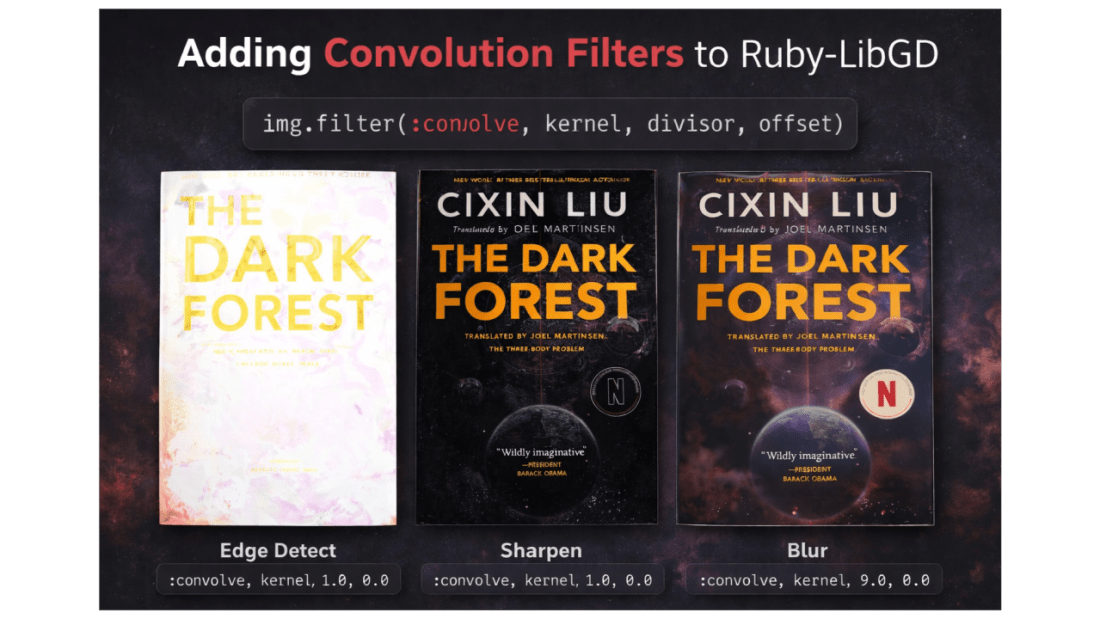
Understanding Convolution Filters in Image Processing (and Adding Them to Ruby-LibGD v0.2.5)

Understanding Convolution Filters in Image Processing (and Adding Them to Ruby-LibGD v0.2.5) March 3, 2026 Today I implemented support for custom convolution filters in Ruby-LibGD, enabling the application of kernels such as blur, sharpen, and edge detection directly from Ruby. At first glance, this may look like just another image filter. In reality, convolution is … Continue reading Understanding Convolution Filters in Image Processing (and Adding Them to Ruby-LibGD v0.2.5)

🚀 The Production-Grade Ruby Microservices Stack (2026)

The Production-Grade Ruby Microservices Stack (2026) March 2, 2026 Microservices don’t fail because of Ruby. They fail because of architecture. Most “microservices” I see in Ruby are: • HTTP chains tightly coupled together • Shared databases behind the scenes • No tracing • No event replay • No contract validation That’s not distributed architecture. That’s … Continue reading 🚀 The Production-Grade Ruby Microservices Stack (2026)

🇯🇵 Kaigi 2026 Is Approaching — Why the Global Ruby Community Should Pay Close Attention

Kaigi 2026 Is Approaching — Why the Global Ruby Community Should Pay Close Attention March 2, 2026 With April approaching, RubyKaigi 2026 is about to take place in Hakodate, Japan — and for the global Ruby community, this is not just another date on the calendar. It is a moment that often defines the technological … Continue reading 🇯🇵 Kaigi 2026 Is Approaching — Why the Global Ruby Community Should Pay Close Attention

🚀 Terminal UX in Ruby: Beautiful Tools Without Leaving the Shell

March 1, 2026 The Modern CLI Stack Beyond puts Ruby is often associated with web applications, background jobs, and scripting. But quietly — almost underground — a rich ecosystem has emerged for building modern, interactive, polished terminal applications. Not the old “print some text and parse ARGV” style. We’re talking about tools that feel closer … Continue reading 🚀 Terminal UX in Ruby: Beautiful Tools Without Leaving the Shell