

July 27, 2026
Every week, This Week in Rails highlights the latest changes merged into the framework. Most weeks, it’s easy to focus on the individual features. But the July 10 edition suggests something more interesting: a broader trend in how Rails is evolving.
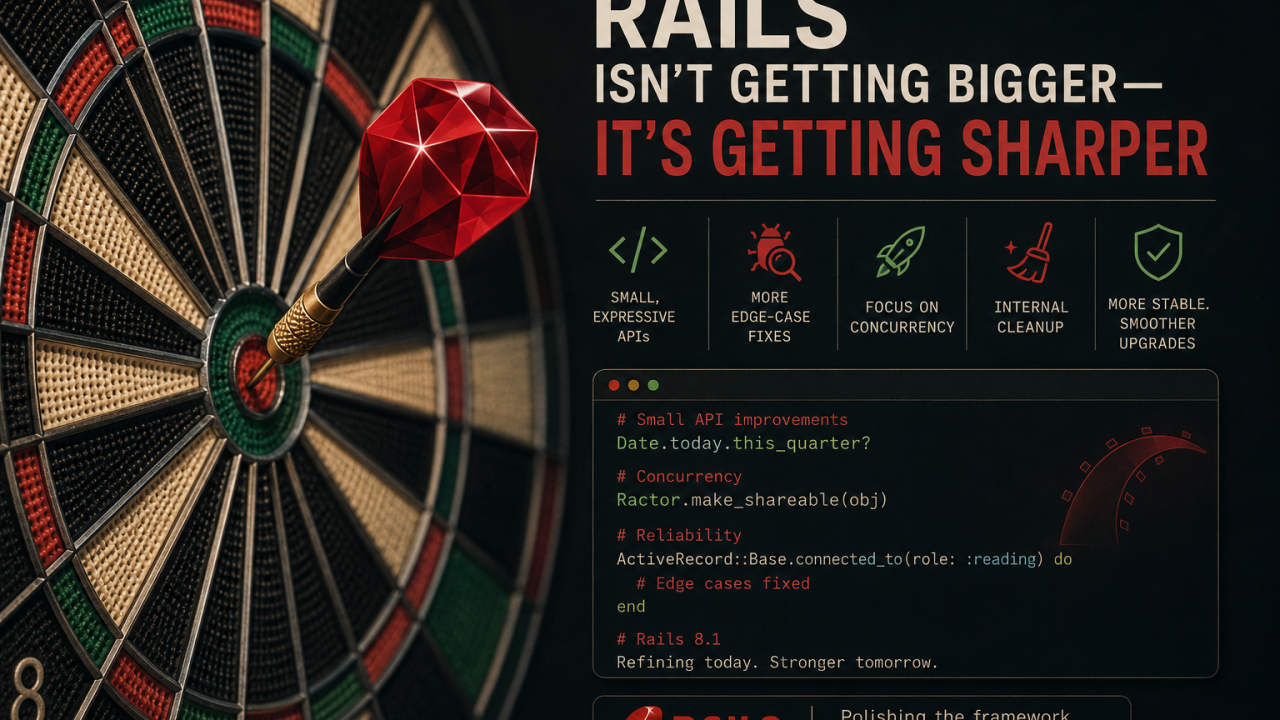
Instead of shipping large, headline-grabbing features, the Rails core team continues to refine the framework through a steady stream of small, high-impact improvements. Looking at recent Rails 8.1 development, a clear pattern emerges:
- Fewer major features.
- More edge-case fixes.
- Greater focus on concurrency.
- Continuous internal cleanup.
- Small, expressive APIs that improve developer ergonomics.
The latest updates are good examples of this philosophy in action.


Small APIs, Better Code
One of the additions is Date#this_quarter?:
Date.today.this_quarter?
It’s a tiny feature, but it replaces more verbose comparisons with an intention-revealing API. This kind of improvement doesn’t change what Rails can do it makes everyday code easier to read and maintain.
Reliability Over Flashiness
The update also includes improvements to Rails’ configuration parsing, addressing subtle edge cases that most developers will never notice unless they encounter them.
These kinds of changes rarely make headlines, but they’re exactly the type of work that reduces unexpected behavior and makes the framework more dependable over time.
Polishing Active Record
Several fixes target Active Record associations and corner cases.
Again, these aren’t new capabilities. They’re refinements that make existing behavior more consistent and predictable, especially in complex applications where edge cases eventually become production issues.
Preparing for Ruby’s Future
Another recurring theme is continued work toward better Ractor compatibility.
While relatively few Rails applications use Ractors today, the ongoing effort to reduce shared mutable state shows that Rails is aligning itself with Ruby’s long-term concurrency roadmap instead of waiting until the ecosystem demands it.
The Bigger Picture
None of these changes are revolutionary on their own.
Taken together, however, they reveal a deliberate direction for Rails.
Rather than expanding the framework with increasingly large features, the core team appears focused on polishing what already exists: reducing technical debt, improving correctness, strengthening concurrency support, and making the developer experience incrementally better.
This philosophy has always been one of Rails’ strengths. The framework evolves through hundreds of thoughtful refinements that, over time, make applications more stable, upgrades smoother, and codebases easier to maintain.
Sometimes the most important release isn’t the one that introduces the biggest feature it’s the one that quietly makes everything else work a little better.