

June 21, 2026
Upgrading a Ruby application is rarely as simple as changing the version number. Dependencies, deployment pipelines, CI environments, and legacy code often mean that a runtime upgrade becomes a project of its own. As a result, many teams postpone adopting newer Ruby language features until the entire application has been upgraded.
This is exactly the kind of problem Ruby Next was designed to solve.
Rather than forcing developers to choose between modern syntax and compatibility with older Ruby versions, Ruby Next provides a bridge that allows applications to evolve incrementally. Although it is commonly associated with gem authors, it can also be a valuable tool for large applications undergoing a gradual modernization.


What Is Ruby Next?
Ruby Next is an open-source project that enables developers to write code using newer Ruby syntax and APIs while maintaining compatibility with older Ruby interpreters.
It accomplishes this through two complementary techniques:
- Syntax transpilation, converting newer Ruby syntax into equivalent code understood by older interpreters.
- Core extensions (polyfills), providing implementations of standard library methods that may not exist in previous Ruby versions.
The concept is similar to how Babel has long allowed JavaScript developers to write modern ECMAScript while supporting older browsers.
Instead of delaying improvements until a complete runtime migration is finished, Ruby Next allows teams to begin modernizing their codebase immediately.
How Does It Work?
Suppose your application is still running on an older Ruby version, but your team would like to adopt more expressive syntax introduced in recent releases.
Consider the endless method definition:
def square(x) = x * x
If the target interpreter does not support this syntax, Ruby Next can transpile it into an equivalent implementation:
def square(x) x * xend
The resulting code behaves identically, but remains compatible with the older runtime.
The same principle applies to many language features and standard library additions introduced across Ruby releases.
Gradual Modernization Instead of a Big-Bang Upgrade
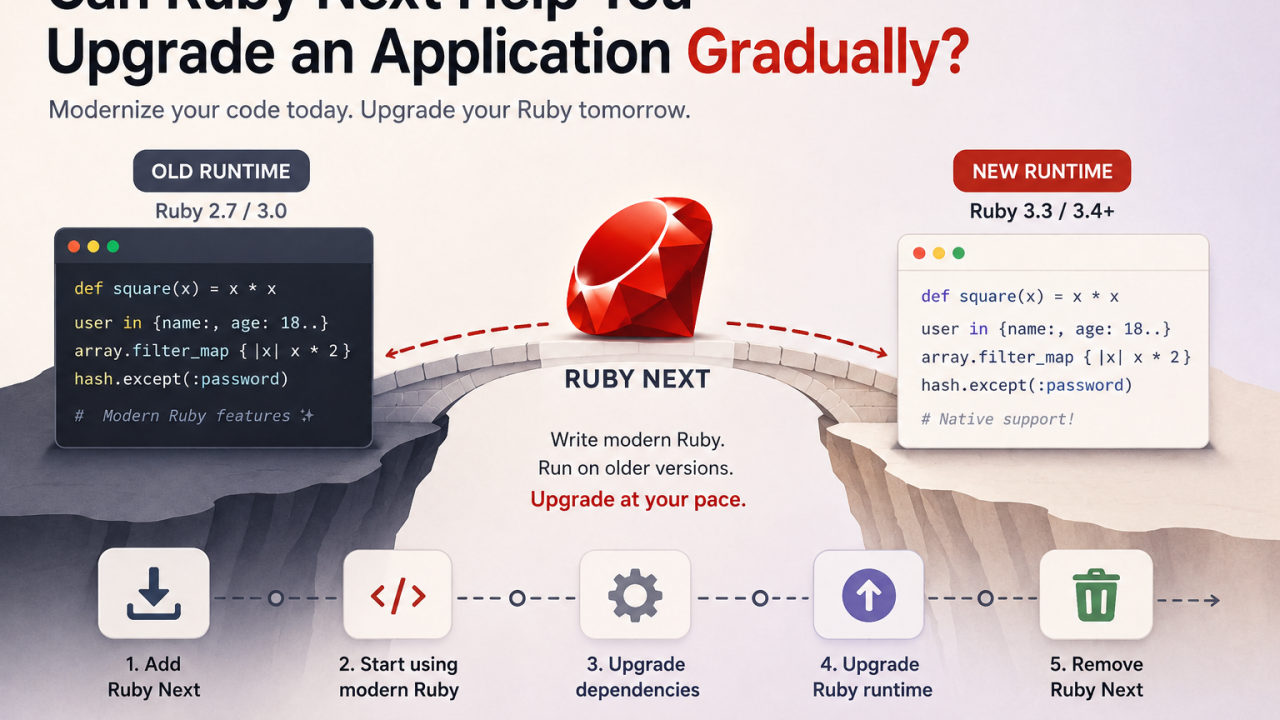
One of the most interesting applications of Ruby Next is separating language modernization from runtime modernization.
Imagine a Rails application running on Ruby 3.0. Upgrading to the latest Ruby version may require:
- Updating dozens of gems.
- Adjusting deployment infrastructure.
- Modifying CI pipelines.
- Validating production behavior.
- Coordinating changes across multiple teams.
This process may take weeks or even months.
Without Ruby Next, developers often postpone using newer language features until every dependency has been updated.
With Ruby Next, the workflow can become much more incremental:
- Add Ruby Next to the project.
- Begin writing modern Ruby where appropriate.
- Continue upgrading dependencies over time.
- Upgrade the Ruby interpreter once the ecosystem is ready.
- Remove Ruby Next when it is no longer necessary.
Instead of one large migration, the application evolves through a series of smaller, lower-risk improvements.
Is It Still Relevant?
As the Ruby community has largely adopted Ruby 3.x, the original motivation behind Ruby Next has become less universal than it was several years ago.
Nevertheless, there are still situations where it offers significant value:
- Long-lived enterprise applications.
- Large Rails monoliths.
- Teams maintaining compatibility across multiple Ruby versions.
- Organizations where infrastructure upgrades occur less frequently than application development.
In these environments, reducing the coupling between code modernization and runtime upgrades can simplify maintenance and decrease migration risk.
Conclusion
Ruby Next is more than a compatibility layer—it is a strategy for evolving Ruby applications incrementally.
While many developers associate it with supporting older Ruby versions, its broader contribution is enabling gradual adoption of modern language features without forcing an immediate runtime upgrade.
Not every project will need it. If your application already tracks the latest Ruby releases, Ruby Next may provide little additional value.
However, for teams maintaining mature applications with complex upgrade paths, it offers an elegant way to modernize code continuously instead of waiting for a single, disruptive migration.
In software engineering, the safest upgrade is often not the fastest one—it is the one that can be performed gradually. Ruby Next was built with exactly that philosophy in mind.

 Linking Ruby knowledge from the most remote places in the world.