

May 12, 2026
If you still think Ruby’s Array is “just a C struct with some methods on top,” you’re about 5 years out of date.
Modern MRI tells a very different story.
Today, Array sits at the intersection of:
- Ruby code (array.rb)
- VM intrinsics (Primitive.*)
- C runtime (array.c)
- JIT specialization (YJIT)
And the result is something much more interesting:
Ruby is starting to describe its own execution model.
Let’s walk through what’s actually happening under the hood.


🧩 The Illusion: “This Looks Like Ruby”
Open array.rb and you’ll see familiar methods:
def shuffle!(random: Random) Primitive.rb_ary_shuffle_bang(random)end
Looks like Ruby. It’s not.
That Primitive.* call is not a method—it’s a VM intrinsic.
This line:
Primitive.rb_ary_shuffle_bang(random)
is effectively:
“jump directly into a VM-level operation, skipping normal Ruby dispatch”
So instead of:
Ruby → method lookup → Ruby body → C
You get:
Ruby → VM intrinsic → C
No detours.
⚙️ Primitive.cexpr!: Ruby as a Thin IR Layer
Now look at first:
def first n = unspecified = true if Primitive.mandatory_only? Primitive.attr! :leaf Primitive.cexpr! %q{ ary_first(self) }
This is where things get serious.
Primitive.cexpr! means:
“replace this Ruby method body with this C expression”
So:
a.first
becomes:
ary_first(self)
with almost zero overhead.
But here’s the twist:
It’s still written in Ruby syntax.
This is not just binding to C.
It’s declaring execution to the VM.
⚡ Arity Specialization: Killing Generic Paths
Take sample:
def sample(n = (ary = false), random: Random) if Primitive.mandatory_only? Primitive.ary_sample0 else Primitive.ary_sample(random, n, ary) endend
MRI splits:
- sample
- sample(n)
into different execution paths
Why?
Because generic argument handling is slow.
So instead of:
one flexible method with branches
MRI builds:
multiple specialized entry points
This is classic JIT strategy:
- fewer conditionals
- more predictable execution
- better inlining
🔥 The Big Shift: Rewriting Core Methods for JIT
Now the real transformation begins:
with_jit do
Inside this block, MRI does something radical:
- removes existing methods
- rewrites them in Ruby
- uses only VM intrinsics
Example: each
def each Primitive.attr! :inline_block, :c_trace, :without_interrupts i = 0 until Primitive.rb_jit_ary_at_end(i) yield Primitive.rb_jit_ary_at(i) i = Primitive.rb_jit_fixnum_inc(i) end selfend
This is not idiomatic Ruby.
This is:
a hand-written, JIT-friendly loop
🧠 Why This Is Faster Than C (Sometimes)
That sounds backwards, but here’s why it works.
Old approach (C implementation)
- opaque to the JIT
- no inlining across boundary
- fixed behavior
New approach (Ruby + intrinsics)
- fully visible to YJIT
- control flow is explicit
- operations are predictable
So YJIT can turn this into something very close to:
for (i = 0; i < len; i++) { yield(array[i]);}
In other words:
Ruby code becomes compiler-friendly IR
🏎️ map / select: Manual Vector Construction
Look at map:
result = Primitive.ary_sized_alloc
This is not:
result = []
It’s:
pre-sized allocation
Then:
Primitive.rb_jit_ary_push(result, value)
This avoids:
- repeated reallocations
- capacity growth checks
- memory churn
MRI is manually building what looks like a C-style dynamic array loop.
⛔ Interrupt Suppression: Raw Throughput Mode
Every JIT-optimized method includes:
Primitive.attr! :without_interrupts
This disables:
- thread scheduling checks
- signal handling inside the loop
Why?
Because those checks are expensive.
MRI is explicitly choosing:
maximum throughput over responsiveness
for hot paths.
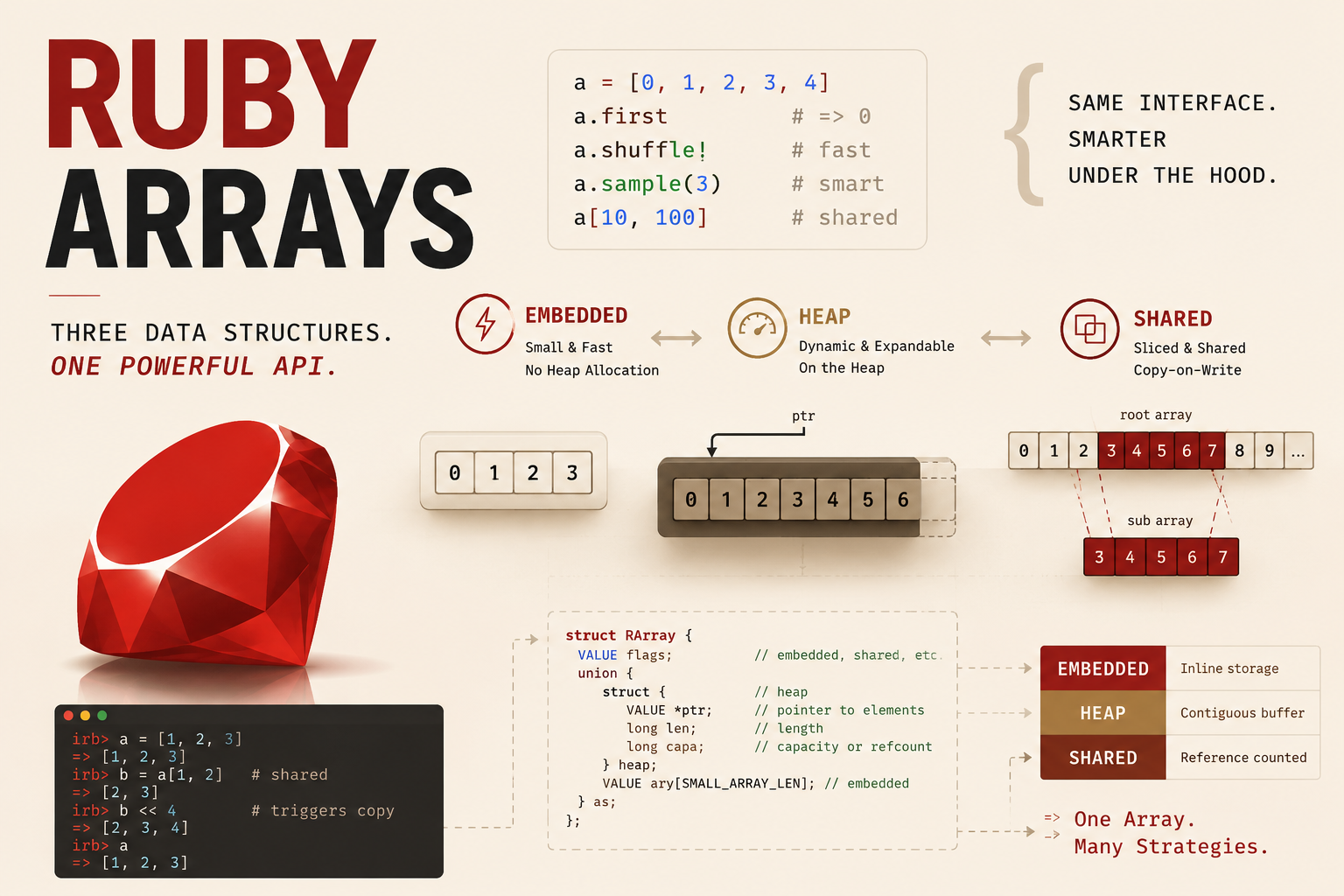
📦 Meanwhile, Underneath: Three Array Representations
All of this sits on top of array.c, where arrays are not just arrays.
They are:
RepresentationPurposeEmbeddedsmall arrays (no heap allocation)Heapstandard dynamic arraysSharedcopy-on-write slices
Embedded arrays
Small arrays live inside the object itself:
[1, 2, 3]
No malloc. No pointer chasing.
Shared arrays (copy-on-write)
slice = array[10, 100]
May not copy anything.
Instead:
- shares memory
- copies only on mutation
Classic COW optimization.
🧠 What This Really Means
This is the important part.
MRI is no longer just:
a C interpreter for Ruby
It’s becoming:
a hybrid VM where Ruby itself helps define optimized execution
We now have:
LayerRoleRuby (array.rb)VM-visible logicIntrinsics (Primitive.*)IR / operationsC (array.c)memory + core opsYJITspecialization engine
🚨 One Important Clarification
This is not a tracing JIT.
YJIT uses:
basic block versioning (BBV)
Meaning:
- compiles small regions
- specializes based on observed types
- avoids long trace recording
This keeps things:
- simpler
- more predictable
- easier to maintain
🧩 The New Mental Model
Forget:
“Array is implemented in C”
Think:
Array is a polymorphic runtime structure with JIT-specialized behavior described in Ruby
Or more bluntly:
Array is three data structures in a trench coat, driven by a VM that now understands Ruby itself
🏁 Final Takeaway
This file is not just an implementation detail.
It’s a signal.
MRI is shifting toward:
- Ruby-defined core behavior
- VM-aware intrinsics
- JIT-specialized execution paths
And in that world:
Writing Ruby the right way can be as optimizable as writing C.

 Linking Ruby knowledge from the most remote places in the world.