

May 6, 2026
Reference: Ruby Parser開発日誌 – Hash pattern対応 (Day 42)


Ruby’s pattern matching feature has evolved significantly since its introduction in Ruby 2.7. A recent development in the Ruby parser implementation (updating how Hash patterns are compiled) represents important infrastructure work that will benefit all Ruby developers, even if you don’t think about pattern matching every day.
What Is Hash Pattern Matching?
If you’re new to pattern matching in Ruby, hash patterns let you destructure and match hash values in case statements:
def process_user(data) case data in {name: String, age: Integer} "User: #{data[:name]}, age #{data[:age]}" in {name: String} "Name only: #{data[:name]}" else "Unknown format" endendprocess_user({name: "Alice", age: 30})# => "User: Alice, age 30"process_user({name: "Bob"})# => "Name only: Bob"
This is powerful for validation and destructuring in a single operation. But behind the scenes, Ruby’s parser and compiler need to convert this pattern-matching syntax into efficient bytecode.
The Parser Refactoring Project
The blog post documents Day 42 of an ongoing effort to restructure how Ruby’s parser represents pattern matching nodes internally. This is part of a larger modernization initiative to make the parser’s node structures more consistent and maintainable.
Old vs. New Node Structure
Previously, hash patterns were represented using a NODE_HSHPTN structure with fields like:
- nd_pconst – the hash constant (if any)
- nd_pkwargs – the keyword arguments (pattern elements)
- nd_pkwrestarg – the rest parameter (**rest)
The new implementation introduces HashPatternNode with clearer semantics:
- constant – the hash constant
- elements – the pattern elements (AssocNode objects)
- rest – the rest parameter (if present)
Why This Matters
While this might sound like internal plumbing, structural improvements in the parser have real benefits:
- Maintainability: Clearer naming and structure make the codebase easier to understand and modify for Ruby maintainers.
- Correctness: The new structure more accurately represents the four distinct forms of rest parameters in hash patterns.
- Performance: Simplified internal structures can lead to more efficient compilation.
- Future Features: A well-structured parser makes it easier to add new pattern-matching features.
The Four Forms of Hash Pattern Rest
One subtle but important detail the refactoring clarifies: hash patterns have four different rest forms, and they must compile differently:
# 1. No rest - matches hashes with at least these keysin {k: :v}# Compiles to: check for key :k with value :v# 2. Named rest - captures extra keys in a variablein {k: :v, **rest}# Compiles to: capture remaining key-value pairs in 'rest'# 3. Empty rest - allows extra keys but don't capture themin {k: :v, **}# Compiles to: allows extra keys but doesn't bind them# 4. Forbidden rest - no extra keys allowedin {k: :v, **nil}# Compiles to: verify no extra keys exist
This distinction affects the generated bytecode significantly. For example, with **rest, the compiler generates different code that captures extra keys, while with **nil, it generates code that validates the hash is exact.
Bytecode Generation
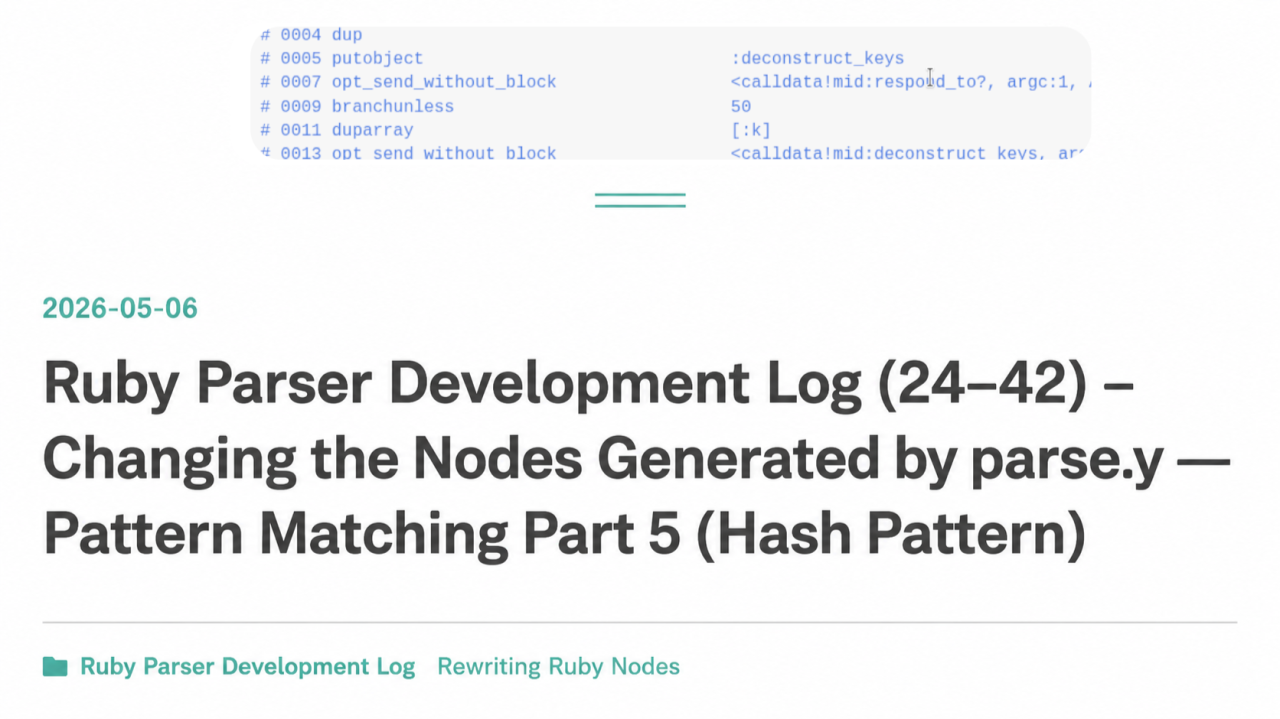
The blog post details how Ruby compiles hash pattern matching into bytecode. The generated code:
- Checks if the object responds to #deconstruct_keys
- Calls #deconstruct_keys to get a hash
- Validates the result is actually a Hash
- Checks for required keys using key?
- Matches values using pattern matching
- Handles rest parameters according to their form
Here’s a simplified example of the logic:
def match_hash(value) # Step 1: Does it have deconstruct_keys? if value.respond_to?(:deconstruct_keys) # Step 2: Call it deconstructed = value.deconstruct_keys([:k]) # Step 3: Is it a hash? if deconstructed.is_a?(Hash) # Step 4-5: Check key and match value if deconstructed.key?(:k) && deconstructed[:k] == :v # Match succeeded return true end end end falseend
Why This Refactoring is Significant
While this refactoring is “internal” in the sense that user-facing syntax doesn’t change, it represents:
- Ongoing Ruby Maintenance: The Ruby core team continuously works to improve the parser and compiler infrastructure.
- Code Quality: Refactoring large systems to be more maintainable benefits the entire community.
- Foundation for Future Work: Pattern matching is still relatively young in Ruby. Better parser structure enables richer pattern features.
- Performance Optimization: Simplified internal structures often lead to better compilation and runtime performance.
What’s Next?
According to the blog post, the pattern matching implementation is approximately 80% complete across all pattern types. The remaining work includes:
- ✅ Value patterns (primitives, ranges, constants)
- ✅ Variable patterns
- ✅ Array patterns
- ✅ Hash patterns (just completed)
- 🔄 Find patterns (next)
- ⏳ Alternative patterns
- ⏳ As patterns
- ⏳ Guard clauses (postfix if/unless)
The Find pattern—used to search for elements matching a pattern within a collection—will be the next focus.
For Ruby Developers
If you use pattern matching in your code, you can expect:
- Better Stability: As the parser is refactored and modernized, edge cases are discovered and fixed.
- Improved Errors: Clearer internal structures often lead to better error messages.
- Potential Performance Gains: More efficient bytecode generation from improved compiler logic.
- More Features: A well-structured parser is the foundation for new pattern-matching capabilities.
Conclusion
The Ruby parser refactoring project, documented in detail by the Ruby maintainers, shows the thoughtful, incremental work that goes into maintaining and improving a language. While hash pattern compilation might seem like a niche topic, it’s part of the broader effort to ensure Ruby remains fast, maintainable, and expressive.
For Ruby Stack News readers interested in language implementation, this work is a great reminder that even “finished” features like pattern matching benefit from ongoing refinement and structural improvement.
Reference: かねこにっき – Ruby Parser開発日誌 (24-42) – Hash pattern対応
Tags: #Ruby #Parser #PatternMatching #RubyInternals #LanguageImplementation

 Linking Ruby knowledge from the most remote places in the world.