
January 6, 2026
Why ruby-libgd is becoming Ruby’s new graphics engine
Yesterday something important happened in the Ruby ecosystem.
I added a native sepia filter to ruby-libgd — Ruby’s new binding to the GD Graphics Library — and with it Ruby took another step toward regaining something it quietly lost over the last decade: a true raster graphics engine.
This was not a Ruby wrapper calling out to ImageMagick. This was not a shell command.
This was pixel-level image processing running directly inside Ruby.
And that changes everything.
Advertise on RubyStackNews
RubyStackNews is a niche publication read by Ruby and Rails developers worldwide. Our audience includes senior engineers, tech leads, and decision-makers from the US, Europe, and Asia.
Sponsorship Options
Your brand featured inside a technical article (clearly marked as sponsored).
Highlighted sponsor section embedded within an article.
Logo + link displayed site-wide in the sidebar.
- Highly targeted Ruby / Rails audience
- Organic traffic from search and developer communities
- No ad networks — direct sponsorships only
Interested in sponsoring RubyStackNews?
Contact via WhatsAppWhy sepia is not “just a filter”
To most people, sepia looks like a nostalgic Instagram effect. To a graphics engine, sepia is something very different:
It is a full color-space transformation.
To apply sepia correctly, an engine must:
- Read every pixel
- Convert RGB to grayscale
- Apply weighted color remapping
- Write the new pixel values back into the raster
That is the same pipeline required for:
- Satellite imagery
- Map tile styling
- Medical imaging
- Scientific visualization
- Data heatmaps
In other words:
If sepia works, the pixel engine works.
By adding sepia to ruby-libgd, I validated that Ruby now has a real image-processing core again.
The problem Ruby has had for years
For a long time, Ruby developers had to rely on:
- ImageMagick
- MiniMagick
- shelling out to external binaries
These tools are powerful, but they are:
- slow
- fragile in production
- memory-hungry
- unsafe when handling untrusted images
They turn a simple task like rendering a chart or generating a map tile into a process orchestration problem.
That is not how serious backend systems should handle graphics.
What Ruby was missing was exactly what PHP, Perl and many server platforms still have:
a small, fast, embeddable raster engine.
That is what libgd provides.
And that is what ruby-libgd exposes to Ruby.
What ruby-libgd actually is
ruby-libgd is a native Ruby binding to the GD Graphics Library, written in C and designed for server-side image rendering.
It gives Ruby direct access to:
- pixel buffers
- drawing primitives
- color models
- filters
- image encoders
No external processes. No shelling out. No fragile pipelines.
Just Ruby calling into a real raster engine.
The sepia filter in action
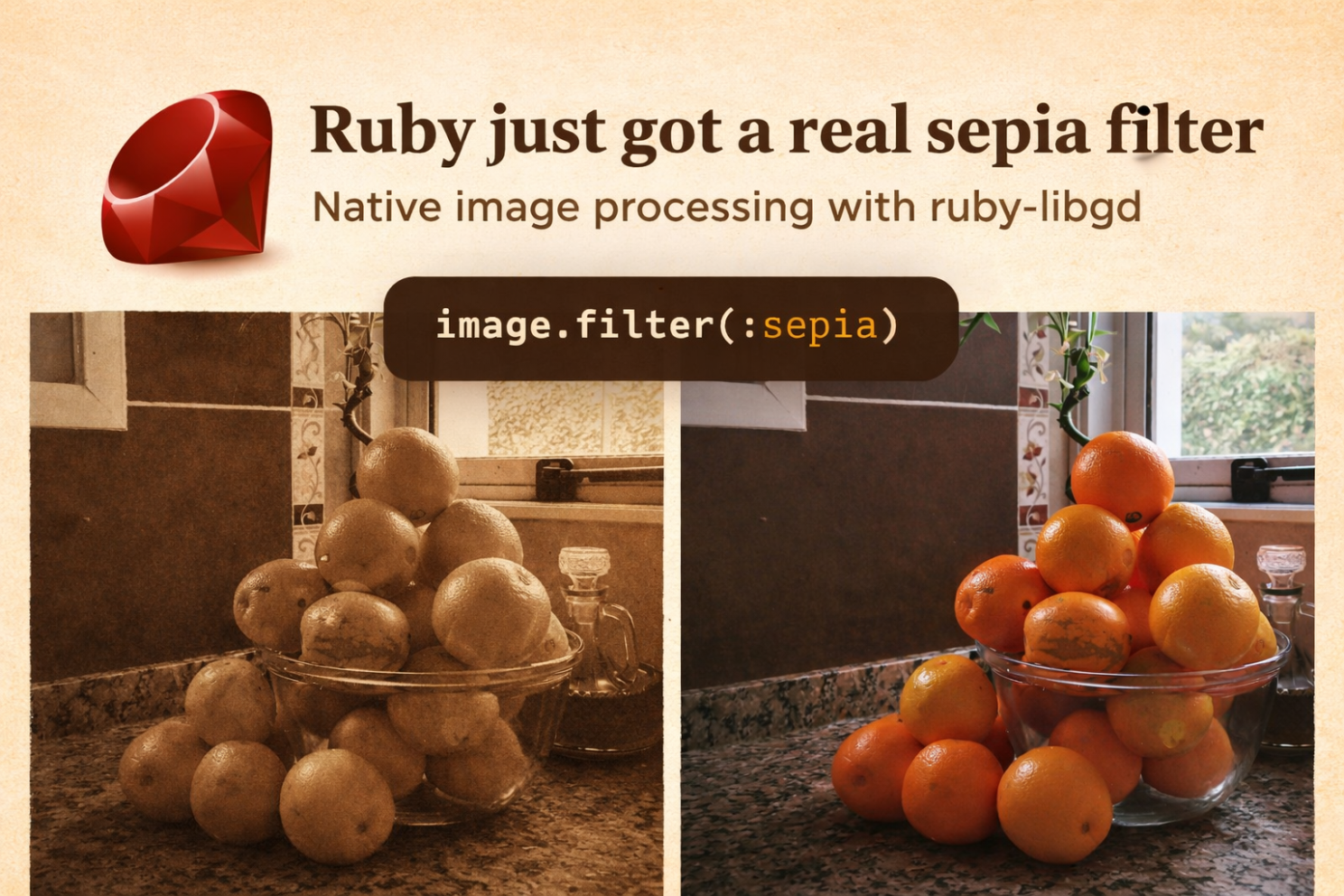
To test the new filter, I used a real photograph: a bowl of oranges under natural light, with glass, shadows, highlights, and texture.
This is not a synthetic test image. It is the kind of photo that exposes whether a raster engine actually works.
Applying:
image.filter(:sepia)
runs entirely inside libgd, transforming the actual pixel data.
The result preserves:
- brightness
- depth
- texture
- highlight detail
Which is exactly what you need for:
- charts
- reports
- dashboards
- maps
- scientific images
See it live
The project already has a full visual gallery showing what Ruby can render now:
🔗 Live demo & examples https://ggerman.github.io/ruby-libgd/
You can browse:
- charts
- plots
- photos
- maps
- dashboards
All rendered natively by Ruby.
The source code is here:
🔗 GitHub https://github.com/ggerman/ruby-libgd
And the gem is available on RubyGems:
🔗 RubyGems https://rubygems.org/gems/ruby-libgd
Why this matters beyond filters
Sepia is not the goal.
It is the proof.
Once you can reliably:
- read pixels
- transform colors
- write them back
- and encode the result
You unlock:
- GIS map tile pipelines
- scientific visualization
- PDF report rendering
- data dashboards
- image processing at scale
This is the foundation Ruby needs to compete in:
- geospatial systems
- data platforms
- reporting infrastructure
- scientific tooling
The bigger picture
At RubyConf 2025, it was openly acknowledged that Ruby struggles with:
- map tile generation
- image rendering
- graphics pipelines
ruby-libgd exists because of that gap.
The sepia filter added yesterday is one more brick in rebuilding Ruby’s graphics stack — not as a wrapper, but as a real engine.
Ruby can create images again.
And now it can color them properly too.

 Linking Ruby knowledge from the most remote places in the world.