Rack Is Still Innovating: The Backbone of Ruby’s Web Stack Keeps Evolving February 26, 2026 In recent months, much of the conversation in the Ruby ecosystem has focused on Ruby 4, Rails 8, concurrency, JIT compilers, and runtime capabilities. But while attention was on the language and frameworks, one critical component — present in every … Continue reading 🧱 Rack Is Still Innovating: The Backbone of Ruby’s Web Stack Keeps Evolving
Tag: technology
🧵 Ruby 4 Concurrency Gets Real: Understanding Ractor::Port in Practice
Ruby has long balanced developer happiness with safety, but parallel performance has historically been constrained by the Global VM Lock (GVL). Ractors — introduced in Ruby 3 — were the first serious attempt to bring true multicore parallelism to MRI without sacrificing thread safety. With Ruby 4, the introduction of Ractor::Port significantly improves how Ractors … Continue reading 🧵 Ruby 4 Concurrency Gets Real: Understanding Ractor::Port in Practice
Neither Too Much nor Too Little: A “Touch Base” on the Current State of AI
Neither Too Much nor Too Little: A “Touch Base” on the Current State of AI February 23, 2026 Motivated by the many comments — some fearful, others excessively enthusiastic — about artificial intelligence, I set out to “touch base”: to ground the discussion with a personal perspective on this tool which, no matter how useful … Continue reading Neither Too Much nor Too Little: A “Touch Base” on the Current State of AI
🧪 Ruby in the Browser? Exploring Rubox and the Future of Ruby WASM
February 22, 2026 A fully client-side Ruby playground powered by WebAssembly — promising, experimental, and not quite ready for prime time Running Ruby directly inside the browser has long been a dream for educators, tooling developers, and the Ruby core community. Thanks to WebAssembly (WASM), that vision is no longer theoretical. Rubox, a browser-based Ruby … Continue reading 🧪 Ruby in the Browser? Exploring Rubox and the Future of Ruby WASM
🧠 RubyKaigi 2024: A Deep Technical Shift in Ruby’s Standard Library (With Real Examples)
February 20, 2026 RubyKaigi 2024 — Historical ContextAlthough this presentation discusses Ruby 3.4–3.5 and the ecosystem has already moved forward to Ruby 4 by 2026, the strategic shift it describes — reducing the traditional standard library and externalizing functionality as gems — represents a fundamental change in Ruby’s philosophy rather than a version-specific roadmap.Understanding this … Continue reading 🧠 RubyKaigi 2024: A Deep Technical Shift in Ruby’s Standard Library (With Real Examples)
What Rails Actually Wants: Tidying Controllers and Views Without Service Object Explosion
February 20, 2026 Lessons from RailsTokyo 2026 on using ActiveRecord as a relational engine—not just an ORM Modern Rails teams often inherit a paradox: controllers must be “thin,” views must be “dumb,” models must be “fat,” and yet production apps accumulate service objects, query objects, presenters, decorators, serializers, policies, and helpers until the architecture resembles … Continue reading What Rails Actually Wants: Tidying Controllers and Views Without Service Object Explosion
Stop Checking admin?: Designing Authorization That Won’t Become Technical Debt (Kaigi on Rails 2025)
February 17, 2026 Modern Rails applications rarely fail because of authentication — they fail because of authorization complexity. As products grow, roles multiply, exceptions accumulate, and permission checks scatter across controllers, models, views, and frontend code. What begins as a simple current_user.admin? quickly becomes an unmaintainable web of implicit rules. At Kaigi on Rails 2025, … Continue reading Stop Checking admin?: Designing Authorization That Won’t Become Technical Debt (Kaigi on Rails 2025)
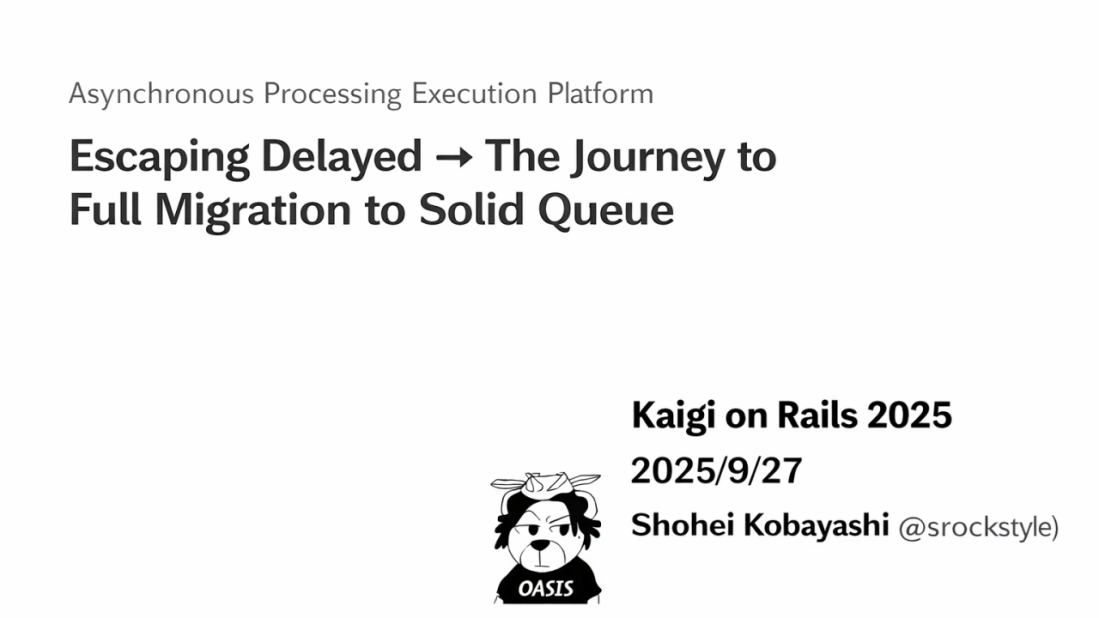
From Delayed Job to Solid Queue: How a 10-Year Rails App Finally Achieved Linear Scaling
From Delayed Job to Solid Queue: How a 10-Year Rails App Finally Achieved Linear Scaling February 16, 2026 Lessons from Kaigi on Rails 2025 — Shohei Kobayashi In large Rails systems, background jobs are not a detail — they are the system. Email delivery, AI processing, document generation, data cleanup, notifications, analytics pipelines — everything … Continue reading From Delayed Job to Solid Queue: How a 10-Year Rails App Finally Achieved Linear Scaling
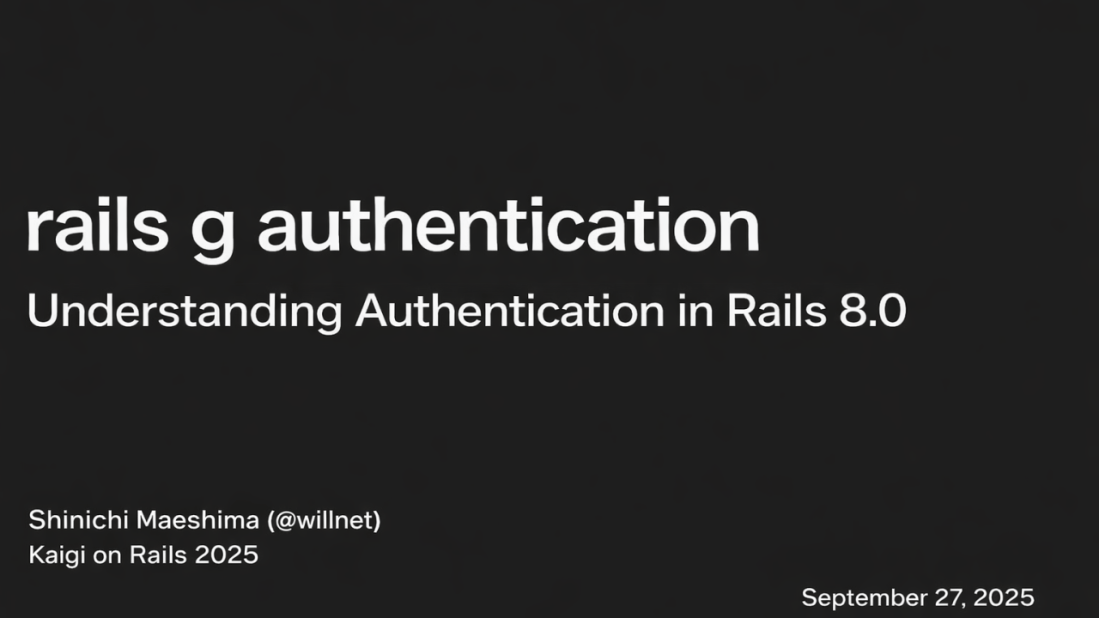
Rails 8 Authentication: Why the New Built-in Generator Matters (and What It Means for Devise)
February 16, 2026 In 2025, at Rails g authentication from Kaigi on Rails 2025, developer Shinichi Maeshima presented an insightful talk on Rails 8’s new rails g authentication generator and its implications for how we build authentication in Rails apps. Rails has long given developers the building blocks for authentication — has_secure_password, session cookies, and … Continue reading Rails 8 Authentication: Why the New Built-in Generator Matters (and What It Means for Devise)
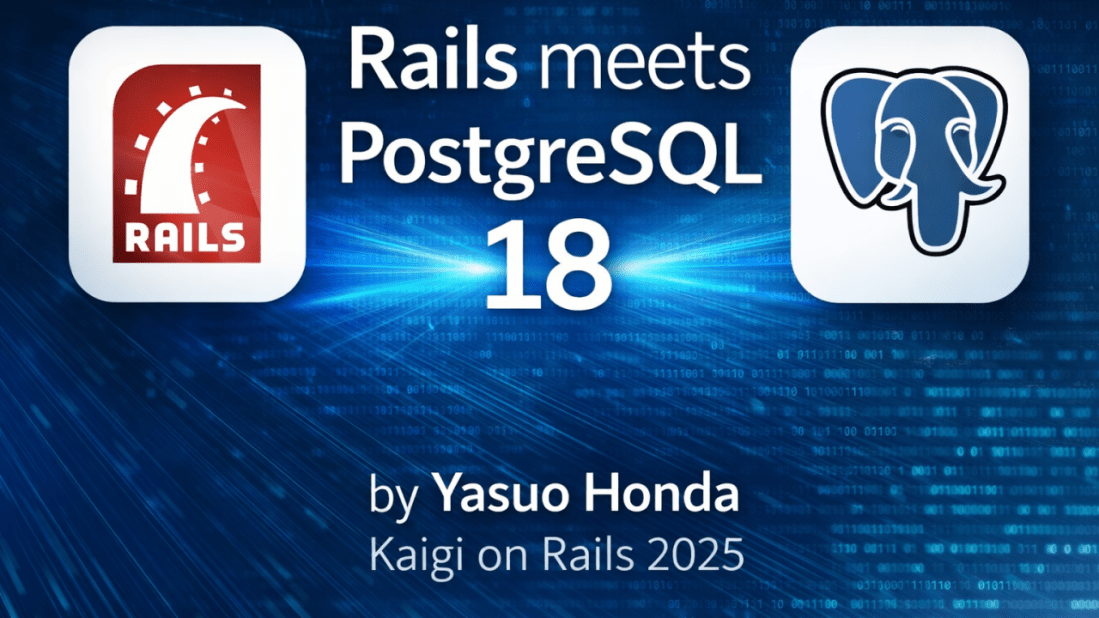
Rails Meets PostgreSQL 18
February 11, 2026 Compatibility, Protocol Changes, and Virtual Generated Columns in Rails 8.1 At Kaigi on Rails 2025, Rails Committer Yasuo Honda delivered a deep technical walkthrough titled: Rails meets PostgreSQL 18 PostgreSQL 18 was officially released on September 25, 2025, and the talk explains how Rails adapts — not just at the marketing level, … Continue reading Rails Meets PostgreSQL 18