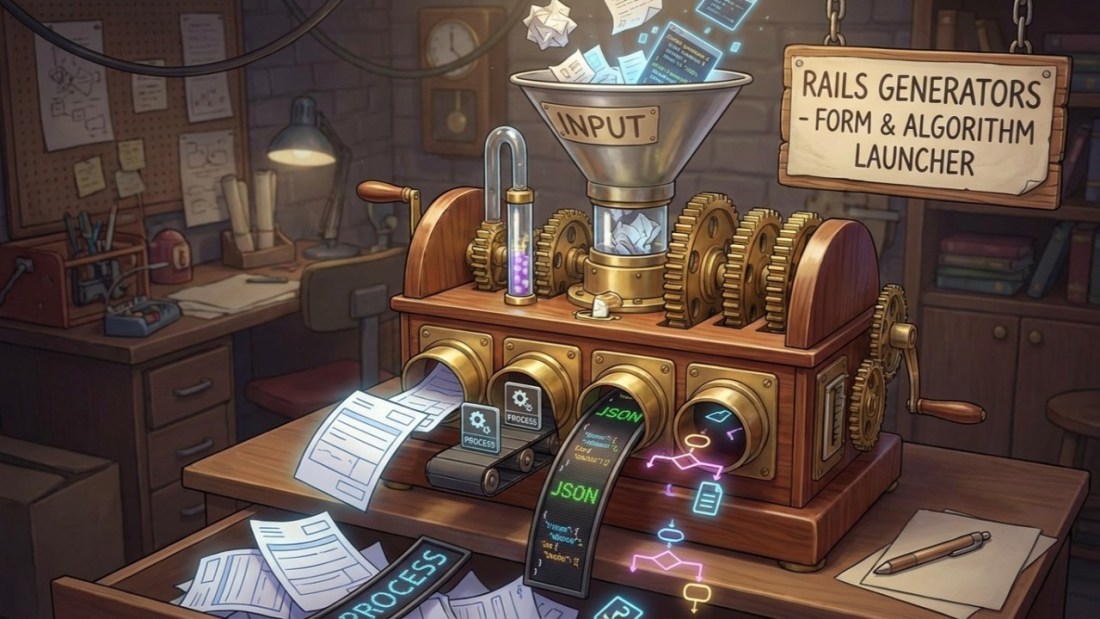
πŸŒ… Building a Ruby on Rails API with Swagger Documentation: A Practical Guide

Building a Ruby on Rails API with Swagger Documentation: A Practical Guide June 10, 2025 As developers, we often find ourselves building APIs that need to be consumed by mobile apps, front-end frameworks, or third-party services. A well-structured, documented, and maintainable API is essential for seamless integration and long-term scalability. In this article, I’ll walk … Continue reading πŸŒ… Building a Ruby on Rails API with Swagger Documentation: A Practical Guide

Generating Executable API Documentation for Ruby on Rails with RSwag

June 9, 2025 A structured exposition with illustrative examples Abstract Accurate, current, and machine-readable documentation is a prerequisite for reliable consumption of web APIs. While manual Swagger (OpenAPI) definitions quickly diverge from production behaviour, RSwag bridges this gap by synthesising documentation directly from integration tests written in RSpec. This article (i) situates RSwag within the … Continue reading Generating Executable API Documentation for Ruby on Rails with RSwag

Supercharging Ruby with Embedded TypedData Objects

June 7, 2025 Ruby continues to evolve, balancing its expressive elegance with a growing focus on performance. One of the latest improvements introduced in Ruby 3.3 is embedded TypedData objects, a low-level optimization with impressive results. This advancement, developed by Peter Zhu and Jean Boussier, is already paying dividends in core Ruby operationsβ€”and soon, third-party … Continue reading Supercharging Ruby with Embedded TypedData Objects

Simulating External APIs in RSpec: A Clean Approach Using WebMock

June 6, 2025 Abstract When testing systems that depend on external services, such as geolocation APIs, simulating HTTP responses becomes essential for building deterministic and isolated test suites. This article explores a disciplined approach to mocking HTTP calls in RSpec using WebMockβ€”without relying on custom helpers or implicit abstractions. Instead, we emphasize clean code principles: … Continue reading Simulating External APIs in RSpec: A Clean Approach Using WebMock

🧼 Skinny Controllers, Fat Models – A Classic Ruby on Rails Guideline

June 5, 2025 In the world of Ruby on Rails, few principles have stood the test of time like the mantra: β€œSkinny Controllers, Fat Models.” While it may sound quirky, this simple phrase encapsulates a deep architectural philosophy that encourages maintainability, clarity, and clean code β€” the Rails way. βœ… What It Really Means The … Continue reading 🧼 Skinny Controllers, Fat Models – A Classic Ruby on Rails Guideline

Understanding Data Structures and Method Operations: A Key to Efficient Software Development

June 4, 2025 In the realm of software engineering, data structures form the fundamental backbone upon which efficient and scalable applications are built. Equally important are the methods β€” or algorithms β€” that operate on these data structures, enabling us to manipulate, access, and transform data effectively. The Importance of Data Structures Data structures are … Continue reading Understanding Data Structures and Method Operations: A Key to Efficient Software Development

πŸš€ Ruby 3.5 Brings Serious Speed to Object Allocation πŸ’Žβš‘

June 3, 2025 If you're like me and enjoy digging into Ruby performance, you’ll appreciate the latest improvements in Ruby 3.5 β€” especially when it comes to how fast objects get allocated. Thanks to optimizations in Class#new, Ruby 3.5 dramatically improves allocation performance for both positional and keyword arguments. And with YJIT enabled, the numbers … Continue reading πŸš€ Ruby 3.5 Brings Serious Speed to Object Allocation πŸ’Žβš‘

Automating Document Generation with AI in Ruby on Rails

June 3, 2025 In modern software projects, automating routine tasks is crucial to speed up delivery and reduce human error. One great example is document generationβ€”whether it's product requirement documents (PRDs), proposals, or presentations. Recently, I worked on a system that uses AI to generate structured content from conversations, then outputs documents in multiple formats … Continue reading Automating Document Generation with AI in Ruby on Rails

🚨 Alert: ZJIT Merge β€” What Ruby | Rails Developers Should Know πŸš¨

June 2, 2025 The Ruby community has reached a significant milestone with the integration of ZJIT into Ruby core. This next-generation Just-In-Time compiler promises to reshape how we think about Ruby performance in production environments. What Makes ZJIT Different? ZJIT represents a fundamental shift in Ruby's approach to runtime optimization. Unlike previous JIT implementations, ZJIT … Continue reading 🚨 Alert: ZJIT Merge β€” What Ruby | Rails Developers Should Know πŸš¨

Building a Microservice Architecture with Ruby: A Practical Guide

June 2, 2025 Introduction Modern applications increasingly adopt a microservice architecture to address scalability and maintainability concerns. This approach breaks down a system into independent, self-contained services, each responsible for a specific domain. Ruby, renowned for its developer-friendly syntax and productivity, provides an excellent foundation for developing microservices, particularly when leveraging the Ruby on Rails … Continue reading Building a Microservice Architecture with Ruby: A Practical Guide