
February 22, 2026
A fully client-side Ruby playground powered by WebAssembly — promising, experimental, and not quite ready for prime time
Running Ruby directly inside the browser has long been a dream for educators, tooling developers, and the Ruby core community. Thanks to WebAssembly (WASM), that vision is no longer theoretical.
Rubox, a browser-based Ruby editor built on Ruby WASM and TypeProf, demonstrates what a fully client-side Ruby environment can look like — no servers, no installation, and no backend infrastructure required.
But beyond the novelty, this project raises deeper questions about the future of Ruby tooling, documentation, and distribution.
You can try Rubox yourself here: https://rubox.vercel.app/
🚀 What Rubox Actually Is
Rubox is a web application that executes real Ruby code entirely in the browser using WebAssembly.
Key characteristics:
- No server-side execution
- No container or remote VM
- Runs fully offline after loading
- Shareable code via URL
- Built-in static analysis with TypeProf
In short:
Think “CodePen for Ruby” — but powered by a real Ruby interpreter.
🧠 TypeProf in the Browser: Static Analysis Without Installation
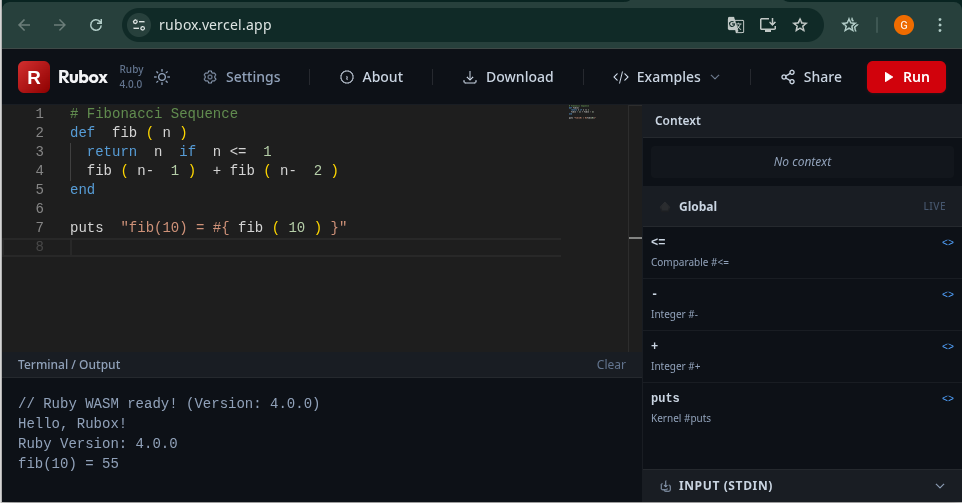
One of the most impressive aspects of Rubox is the integration of TypeProf, Ruby’s official type inference engine.
Inside the browser, it provides:
- Method information
- Type hints
- Navigation assistance
- Contextual insights
This is notable because TypeProf typically requires a local Ruby environment. Running it client-side opens new possibilities for educational tools and interactive documentation.
🔍 Debugging Without puts: The “Measure Value” Feature
Rubox introduces an interesting debugging concept: inspecting variable values at specific execution points without modifying the source code.
Instead of inserting logging statements, the system captures runtime state as the program passes through a line.
For learners, this can be far more intuitive than traditional debugging workflows.
📥 Input Handling: Where Reality Hits
Despite its innovations, Rubox clearly shows the current limitations of Ruby WASM in the browser.
Standard Ruby programs expect real terminal I/O:
name = gets
In a browser environment, there is no terminal. Input must be simulated through JavaScript, typically by replacing $stdin.
This approach works for simple cases but becomes fragile for interactive or complex input scenarios. In practice, programs relying heavily on STDIN or file I/O may behave unpredictably.
⚙️ Under the Hood: Fibers, Workers, and a Single Thread
Ruby is largely synchronous. Browsers are event-driven and asynchronous. WebAssembly runs in a constrained environment.
To prevent freezing the UI, Rubox uses:
- Web Workers to isolate execution
- Fibers for cooperative multitasking
- Message passing between threads
This architecture is clever — but also explains performance hiccups and occasional instability.
🔗 Sharing Code Without a Backend
Rubox avoids databases entirely.
Instead, it:
- Compresses the source code
- Embeds it in the URL hash
- Restores it when the link is opened
This makes programs:
- Instantly shareable
- Embed-ready via iframe
- Persistent without storage
For blogs and documentation, this model is extremely attractive.
⚠️ Performance and Maturity
Ruby WASM is still an evolving technology.
Current constraints include:
- Large initial load size
- Slower execution than native Ruby
- Limited filesystem capabilities
- Restricted concurrency
- Garbage collection overhead
Rubox is best understood as a technology demonstration, not a production-grade development environment.
🌐 Why This Matters for the Ruby Ecosystem
Even with its limitations, Rubox hints at a transformative future.
Potential long-term applications include:
- Interactive tutorials with executable examples
- Documentation that runs real code inline
- Installation-free teaching environments
- Offline developer tools
- Serverless distribution of Ruby applications
For open-source maintainers, this could eventually enable live demos of libraries directly in documentation — something traditionally dominated by JavaScript ecosystems.
🧭 The Bigger Picture: Ruby Without Infrastructure
If Ruby WASM continues to mature, it could redefine how Ruby software is delivered:
- No runtime installation
- No dependency conflicts
- No backend costs for simple tools
- Instant onboarding for newcomers
This aligns with broader industry trends toward client-side execution and portable runtimes.
🧪 Final Verdict
Rubox is not yet a tool you would rely on for serious development.
But it is a compelling glimpse into what Ruby tooling might become in the WebAssembly era.
Today: experimental playground Tomorrow: potentially a foundation for a new class of Ruby applications
For anyone interested in the future of the language, projects like Rubox are worth watching closely.

 Linking Ruby knowledge from the most remote places in the world.