
February 16, 2026
Lessons from Kaigi on Rails 2025 — Shohei Kobayashi
In large Rails systems, background jobs are not a detail — they are the system. Email delivery, AI processing, document generation, data cleanup, notifications, analytics pipelines — everything heavy runs asynchronously.
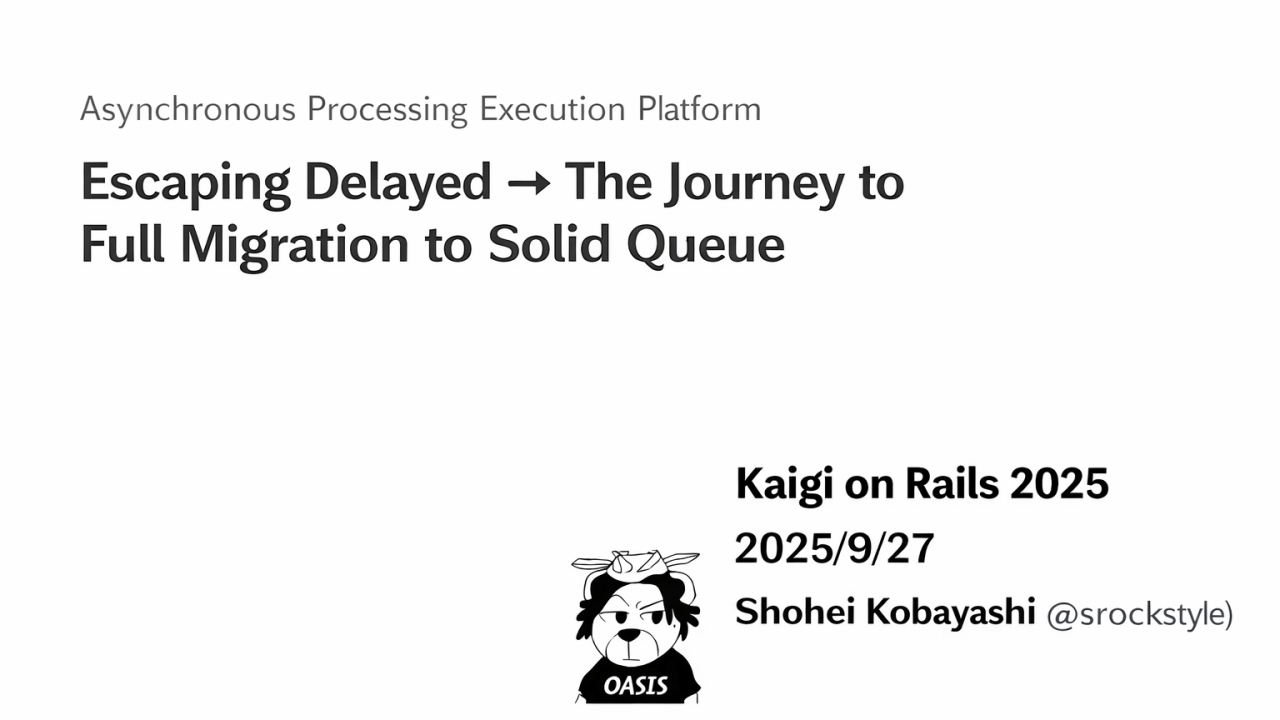
At Kaigi on Rails 2025, Site Reliability Engineer Shohei Kobayashi (@srockstyle) presented a rare, deeply practical story: the full migration of a mature production system from Delayed Job to Solid Queue, Rails’ modern first-party backend for Active Job.
This was not a toy example. It was a decade-old application under real production load.
The Context: A Long-Lived Rails System
The application discussed had been running for over 10 years:
- Originally released in 2012 (Rails 3.2.1)
- Upgraded to Rails 7.1 by 2024
- Heavy reliance on asynchronous processing
- Mixed legacy and modern patterns
- Production infrastructure at scale
As the presentation notes, it was a “Rails application released more than 10 years ago,” evolving across multiple Rails generations. 非同期処理移行の話_kaigionrails2025
Over time, background jobs accumulated into a critical subsystem handling operations such as:
- Initial content generation
- Chatbot interactions
- Email broadcasting
- Data updates
- Customer deletion workflows
- AI-assisted manual creation
- Media processing
In other words: everything expensive.
How Background Jobs Actually Work (Refresher)
Kobayashi begins with the classic asynchronous flow:
- User performs an action
- A job is enqueued in the database
- The user receives a fast response
- A background worker processes the job
- Results are stored back in the database
This architecture is foundational to scalable web apps — but its implementation determines whether scaling actually works.
The Hidden Failure: Why Delayed Job Stops Scaling
Delayed Job stores jobs in the database and workers fetch them using row locks.
At first glance, adding workers should increase throughput.
In reality, it often doesn’t.
The “One Calculator” Problem
The presentation uses a brilliant analogy:
Hiring more clerks does not double throughput if they must share a single calculator.
In database terms:
- Workers compete for the same rows
- One worker locks a job row
- Others wait for the transaction to finish
- Idle time accumulates
- Throughput plateaus
A simplified query pattern looks like:
SELECT * FROM jobsWHERE processed = 'no'FOR UPDATELIMIT 1;Only one worker can lock that row. Others stall.
The presentation explicitly shows that additional workers become “waiting workers” until the transaction commits, meaning performance does not scale linearly. 非同期処理移行の話_kaigionrails2025
Two Types of Asynchronous Work
A key insight from the talk: not all background jobs behave the same.
Type A — Long-Running Jobs
Examples:
- Initial group creation
- Account deletion
- Large data operations
These tolerate latency.
Type B — “Almost Real-Time” Jobs
Examples:
- Email notifications
- Chatbot responses
- AI generation
- System updates
These must execute quickly despite being asynchronous.
A system optimized only for one type fails the other.
Operational Goals of the Migration
The team defined concrete requirements:
- True horizontal scalability
- Increased throughput
- Efficient resource utilization
- Priority control
- Queue isolation per job type
- Unified scheduling system
- Migration to Active Job
- Alignment with “Rails Way”
- Reduced operational complexity
In short: make the job system predictable, scalable, and maintainable.
Why Not Sidekiq Pro?
Sidekiq Pro is powerful — arguably the industry standard — but it was not chosen.
Reasons included:
- Requires Redis (new infrastructure)
- Additional AWS resources
- Licensing cost
- Migration complexity
- Some features not fully accessible via Active Job
The team had a guiding SRE principle:
Do not increase the number of operational components unnecessarily.
Enter Solid Queue
Solid Queue is Rails’ official database-backed job system.
It satisfies several constraints simultaneously:
- Uses existing database infrastructure
- Integrates natively with Active Job
- Supports multiple queues
- Provides scheduling
- Requires no external services
- Scales better than traditional DB-queue systems
The presentation highlights that Solid Queue is developed by the Rails core team and designed for modern Rails applications. 非同期処理移行の話_kaigionrails2025
The Critical Innovation: SKIP LOCKED
Solid Queue solves the core scaling problem with a different locking strategy:
SELECT * FROM jobs_tableFOR UPDATE SKIP LOCKEDLIMIT 1;This means:
- Workers skip rows already locked by others
- No blocking wait
- Workers immediately fetch different jobs
- Parallelism emerges naturally
Returning to the analogy:
Each clerk now has their own calculator.
The result: throughput increases roughly proportionally with worker count.
Infrastructure Simplicity
Another major advantage:
No new infrastructure required.
The team simply created a new database within an existing Aurora instance.
No Redis clusters. No additional services to monitor. No new operational burden.
For organizations prioritizing reliability over novelty, this is decisive.
Migration Strategy (Real-World Safe Approach)
Large systems cannot flip job backends overnight.
The migration proceeded in stages:
1) Eliminate Delayed Job-Specific APIs
Legacy patterns like:
MyClass.delay.do_somethingcreate tight coupling.
These had to be removed first.
2) Standardize on Active Job
Jobs were rewritten as explicit Active Job classes:
class MailJob < ApplicationJob queue_as :mail def perform(user_id:) ... endendDuring transition, jobs could still use the old backend by specifying:
self.queue_adapter = :delayedThis allowed gradual rollout without breaking production.
3) Introduce Solid Queue Configuration
Workers and dispatchers were configured per queue:
- Separate queues for different workloads
- Adjustable polling intervals
- Tunable concurrency
- Process isolation
4) Switch Jobs to the New Backend
Once validated, jobs were pointed to Solid Queue.
5) Remove Delayed Job Completely
Only after stability was confirmed was the legacy system removed.
Observability: The Missing Piece
One weakness of Solid Queue highlighted in the talk:
It does not provide built-in monitoring.
Delayed Job exposes many metrics automatically. Solid Queue does not.
The team implemented custom metrics including:
Queue State Metrics
- Number of pending jobs
- Scheduled jobs
- Running jobs
- Retry counts
Performance Metrics
- Throughput per minute
- Maximum wait time
- Median wait time
- Execution duration
- Lock age
Monitoring these values is essential for detecting backlogs and failures.
Understanding the Internal Job Lifecycle
To operate Solid Queue effectively, the team studied its internal tables:
- Scheduled jobs
- Ready executions
- Claimed executions
- Failed executions
Knowing where a job resides reveals its exact state.
This knowledge is crucial for troubleshooting production incidents.
The Outcome: Linear Scaling Achieved
With Solid Queue:
- Workers no longer block each other
- Throughput scales predictably
- Infrastructure complexity remains low
- Migration risk is controlled
- Legacy patterns are eliminated
The job system becomes a stable, scalable subsystem rather than a hidden bottleneck.
Why This Story Matters to the Rails Ecosystem
This presentation reflects a broader trend:
Rails is reclaiming core infrastructure responsibilities.
Instead of relying exclusively on external services, modern Rails offers first-party solutions that are:
- Good enough for large systems
- Easier to operate
- Deeply integrated
- Cost-efficient
- Predictable
Solid Queue represents a shift toward batteries-included architecture for asynchronous processing.
Final Thoughts
The migration described by Shohei Kobayashi at Kaigi on Rails 2025 is more than a tooling change. It is a case study in how mature systems evolve:
- Identify real bottlenecks
- Define operational goals
- Choose tools aligned with constraints
- Migrate incrementally
- Measure everything
Most importantly, it demonstrates that database-backed queues can scale — if designed correctly.
For teams maintaining long-lived Rails applications, this is not theoretical advice. It is a roadmap.

 Linking Ruby knowledge from the most remote places in the world.