
Senior Ruby Engineer · Open-Source Author (ruby-libgd, libgd-gis) · FinTech & GIS
January 20, 2026
In modern development teams, Proofs of Concept (PoC) are everywhere.
They usually start as Jupyter notebooks: quick experiments, charts, metrics, comparisons, and visual insights. They work well for exploration — but too often, they stop there. The knowledge stays locked inside a notebook, on someone’s machine, disconnected from real systems.
This raises a familiar question:
How do we move insights born in notebooks into real, reproducible, production-grade workflows — without rewriting everything?
This is where Ruby as an orchestration language becomes surprisingly powerful.
PoC Is Not the End — It’s the Beginning
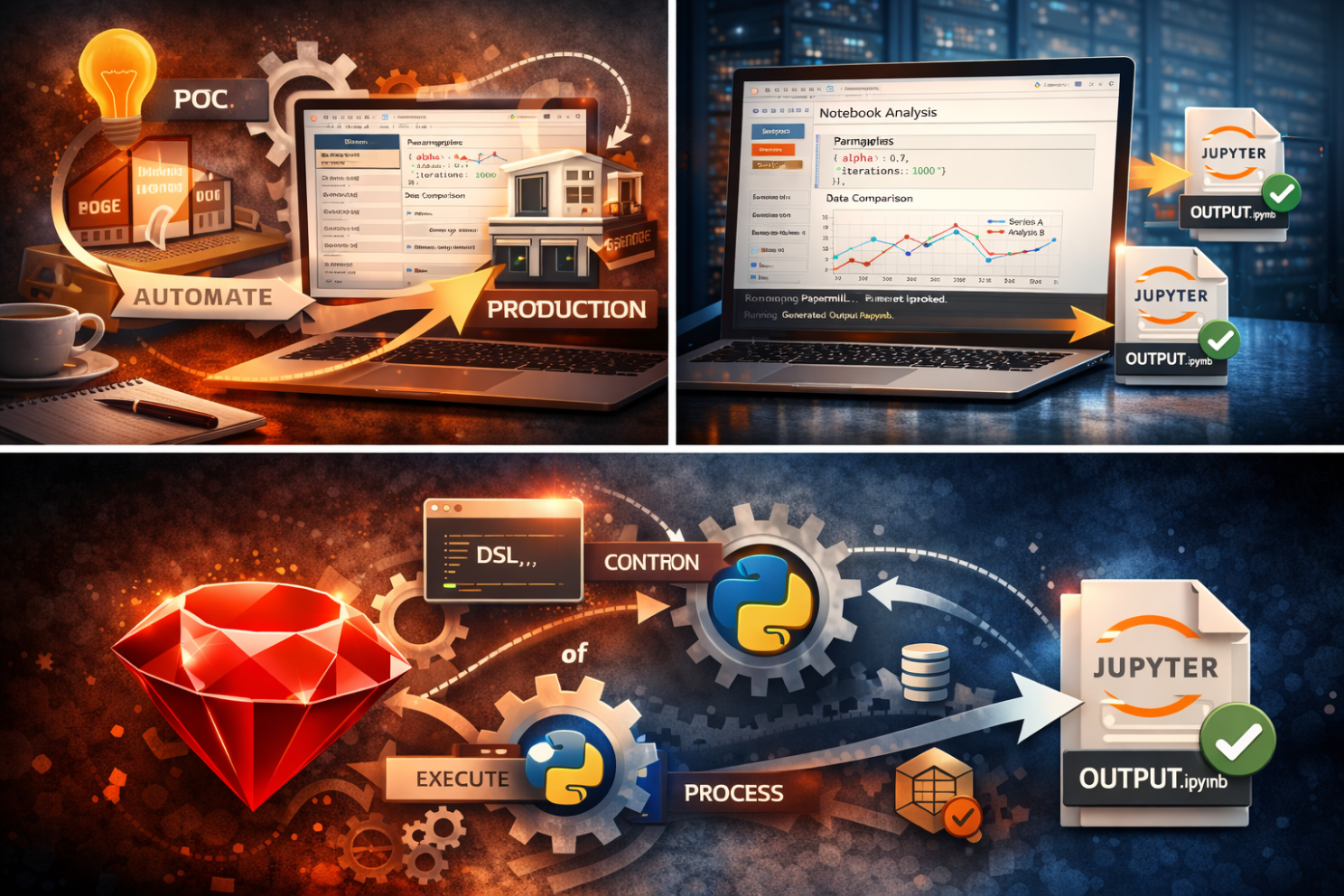
A PoC should not be a dead artifact. It should be the first node in a knowledge circulation system.
Yet in practice, many teams struggle with:
- notebooks that can’t be reproduced reliably
- parameters hard-coded in cells
- ad-hoc execution
- no clear integration with the main application stack
For Ruby teams, this is even more visible when:
- the core system is written in Ruby (Rails, jobs, services)
- but experimentation happens in Python notebooks
- and the two worlds never truly connect
Ruby as the Orchestration Layer
Ruby has always excelled at:
- expressive DSLs
- orchestration
- pipelines
- clear intent over ceremony
Rather than competing with Python’s scientific ecosystem, Ruby can coordinate it.
This philosophy aligns closely with the idea of multi-language collaboration, often discussed in the Ruby community and articulated by Yukihiro Matsumoto:
“Ruby aims to connect people with people, and tools with tools.”
Ruby does not need to execute everything — it needs to connect execution into systems.
Introducing RubyPyMill
RubyPyMill is a lightweight Ruby tool designed precisely for this role.
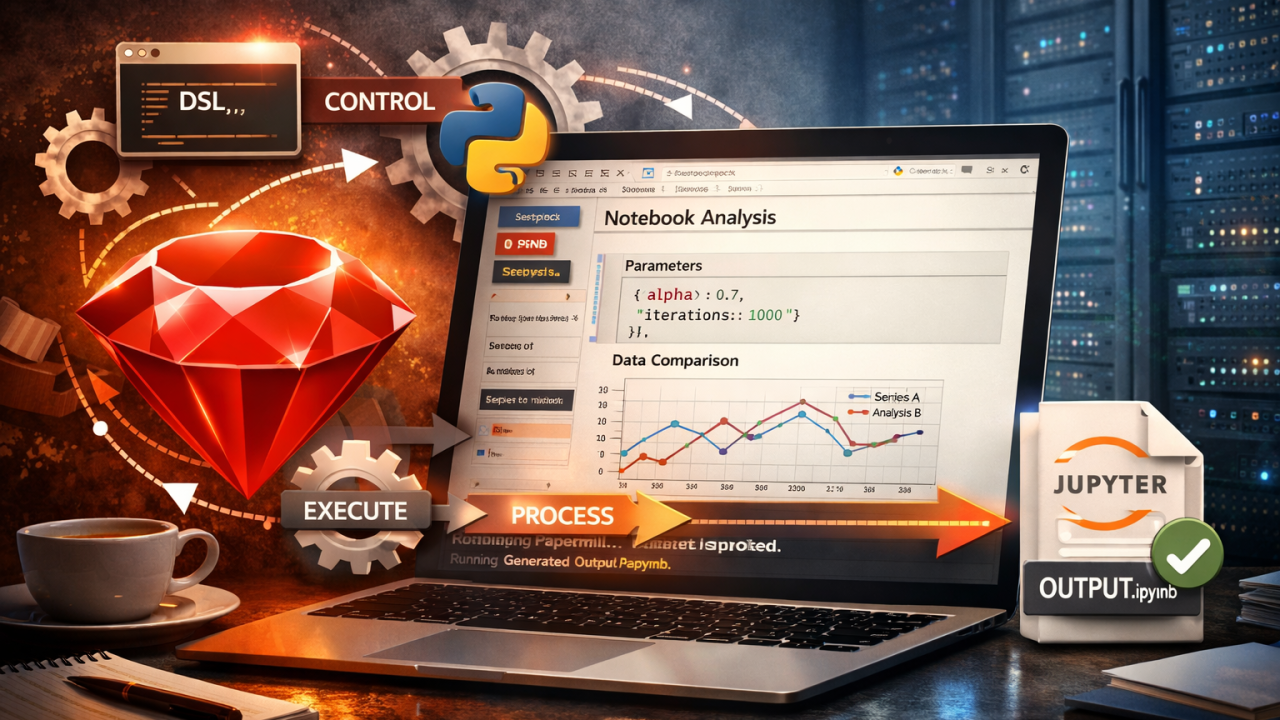
At its core, RubyPyMill allows Ruby to control and orchestrate the execution of Jupyter notebooks using Papermill under the hood.
Important clarification:
- RubyPyMill does not replace notebooks
- It does not reimplement Python tooling
- It does not render charts itself
Instead, it acts as a higher-level execution controller, bringing notebooks into Ruby-driven workflows.
Design Philosophy
RubyPyMill follows a clear separation of responsibilities:
RoleResponsibilityRubyDSLs, orchestration, control, reproducibilityPythonExecution, computation, visualization (notebooks)
This separation is intentional. Ruby defines what should run and how. Python focuses on executing the notebook.
How the Execution Pipeline Works
When RubyPyMill runs a notebook, the flow looks like this:
- Load the notebook as JSON
- Filter cells by tags (while always preserving parameters)
- Inject parameters from JSON files
- Generate a temporary filtered notebook
- Execute it once via Papermill
- Save the executed notebook as an output artifact
This ensures:
- deterministic execution
- reproducibility
- clean separation between setup, analysis, and output
- notebook execution that can be automated and audited
Why Tags Matter
Tag-based execution is one of the most powerful aspects of this approach.
By tagging notebook cells, teams can:
- run only relevant sections
- separate setup from analysis
- avoid unnecessary re-computation
- generate different outputs from the same notebook
This turns notebooks from exploratory scratchpads into structured, reusable assets.
Practical Use Cases
RubyPyMill fits naturally into workflows such as:
- scheduled batch jobs
- CI pipelines
- report generation
- technical comparisons
- automated analysis runs
- Ruby-driven data pipelines
All without opening Jupyter or manually executing cells.
The notebook becomes an executable document, controlled by Ruby.
CLI First, API Second
RubyPyMill is intentionally designed as a CLI-first tool.
- The CLI is stable and production-oriented
- The internal Ruby API exists, but is experimental
This choice reinforces a key idea: automation and reproducibility come before abstractions.
Why This Matters for Ruby Teams
RubyPyMill highlights an important shift:
Ruby is not just a web language. It is increasingly a coordination language.
In a world of heterogeneous tools, Ruby’s role as a glue language — connecting systems, people, and workflows — becomes more relevant than ever.
Final Thoughts
RubyPyMill is not about notebooks. It is about what happens after the notebook.
It acknowledges a reality many teams face and offers a pragmatic solution:
- keep Python where it shines
- bring execution control back into Ruby
- transform PoCs into reproducible system components
For Ruby developers working alongside data-heavy experimentation, this approach feels both modern and deeply Ruby-like.

 Linking Ruby knowledge from the most remote places in the world.