
December 29, 2025
At RubyWorld Conference 2025 and Kaigi on Rails 2025, a talk by Tomohiro Umeda from RIZAP Technologies quietly delivered one of the most important messages for the future of Ruby engineering.
Most companies would love to hire senior engineers. But in reality — especially for growing or less visible tech organizations — hiring enough seniors is often impossible.
So companies end up hiring juniors and high-potential candidates instead.
What separates successful engineering organizations from struggling ones is not who they hire, but whether they have a system to turn those juniors into seniors.
RIZAP Technologies built exactly such a system.
Advertise on RubyStackNews
RubyStackNews is a niche publication read by Ruby and Rails developers worldwide. Our audience includes senior engineers, tech leads, and decision-makers from the US, Europe, and Asia.
Sponsorship Options
Your brand featured inside a technical article (clearly marked as sponsored).
Highlighted sponsor section embedded within an article.
Logo + link displayed site-wide in the sidebar.
- Highly targeted Ruby / Rails audience
- Organic traffic from search and developer communities
- No ad networks — direct sponsorships only
Interested in sponsoring RubyStackNews?
Contact via WhatsAppFrom non-engineer to Ruby conference speaker
Tomohiro Umeda did not start his career in software. He worked in product development, with no programming background, using a computer mainly for email and a web browser.
Through RIZAP Technologies’ internal training program, he became a backend engineer — and within just three years, he was speaking at RubyWorld Conference and Kaigi on Rails about Ruby on Rails architecture and engineering practices.
His personal story reflects what the company built at scale.
In just three years, RIZAP grew from 24 to more than 140 engineers, with over 90% of their Ruby backend team hired as new graduates.
This was not luck. It was engineering.
Why RIZAP could not hire seniors — and what they did instead
RIZAP decided to invest heavily in DX (Digital Transformation), but faced a hard reality:
- They were not known as a tech company
- They could not easily attract experienced engineers
- They needed to move fast anyway
So instead of competing for scarce senior talent, they made a bold decision:
Hire people with potential — and build seniors internally.
But that only works if training is treated as a first-class engineering system, not a side activity.
16 hours to teach one line of Rails
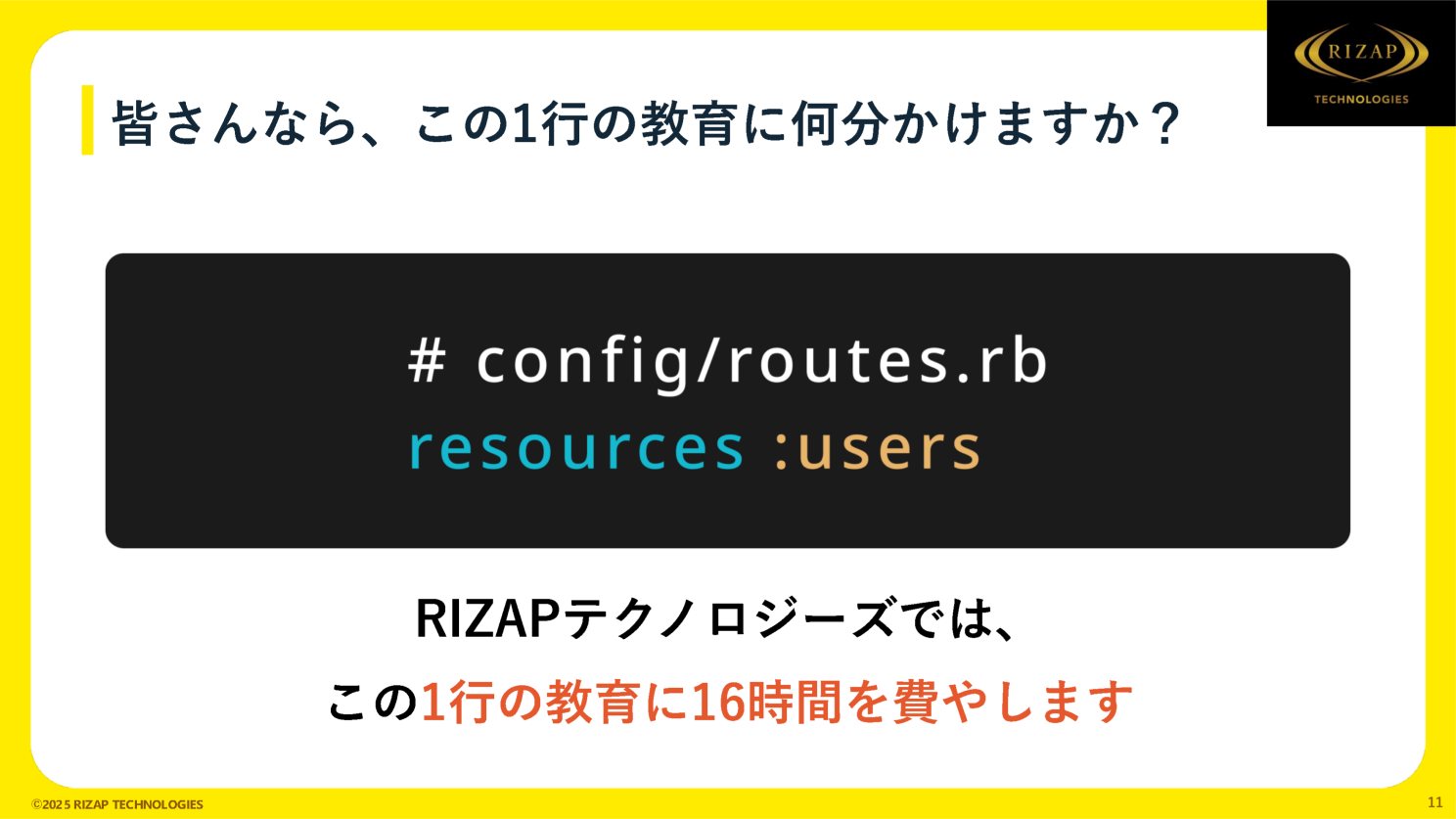
During the talk, Umeda showed this single line of Rails code:
resources :users
And then asked:
“How long would you spend teaching this line?”
At RIZAP, the answer is 16 hours.
Not to explain the syntax — but to explain everything behind it:
- What is a resource?
- Why did DHH name it that way?
- How does HTTP routing work?
- What is a URI?
- Why do GET, POST, PUT and DELETE exist?
- What does REST actually mean?
By the time a junior understands this one line, they also understand how the web itself works.
They are no longer copying Rails code. They are thinking like engineers.
Names, meaning, and Ruby’s design philosophy
One of the key ideas of the talk is that names are not cosmetic.
Rails was designed by people who cared deeply about semantics. Understanding why something is called resources reveals the architecture of the web.
RIZAP trains juniors to ask:
“Why is this named this way?”
That habit turns framework users into software engineers.
Writing as a growth engine
Every RIZAP trainee writes a daily technical report:
- At least 30 minutes
- Around 3,000 characters per day
- No one can clock out until it is written
They must describe:
- What they worked on
- What they learned
- What confused them
- What they still do not understand
This is not bureaucracy — it is deliberate skill building.
Writing forces clarity. Clarity builds engineers.
Communication is how juniors become seniors
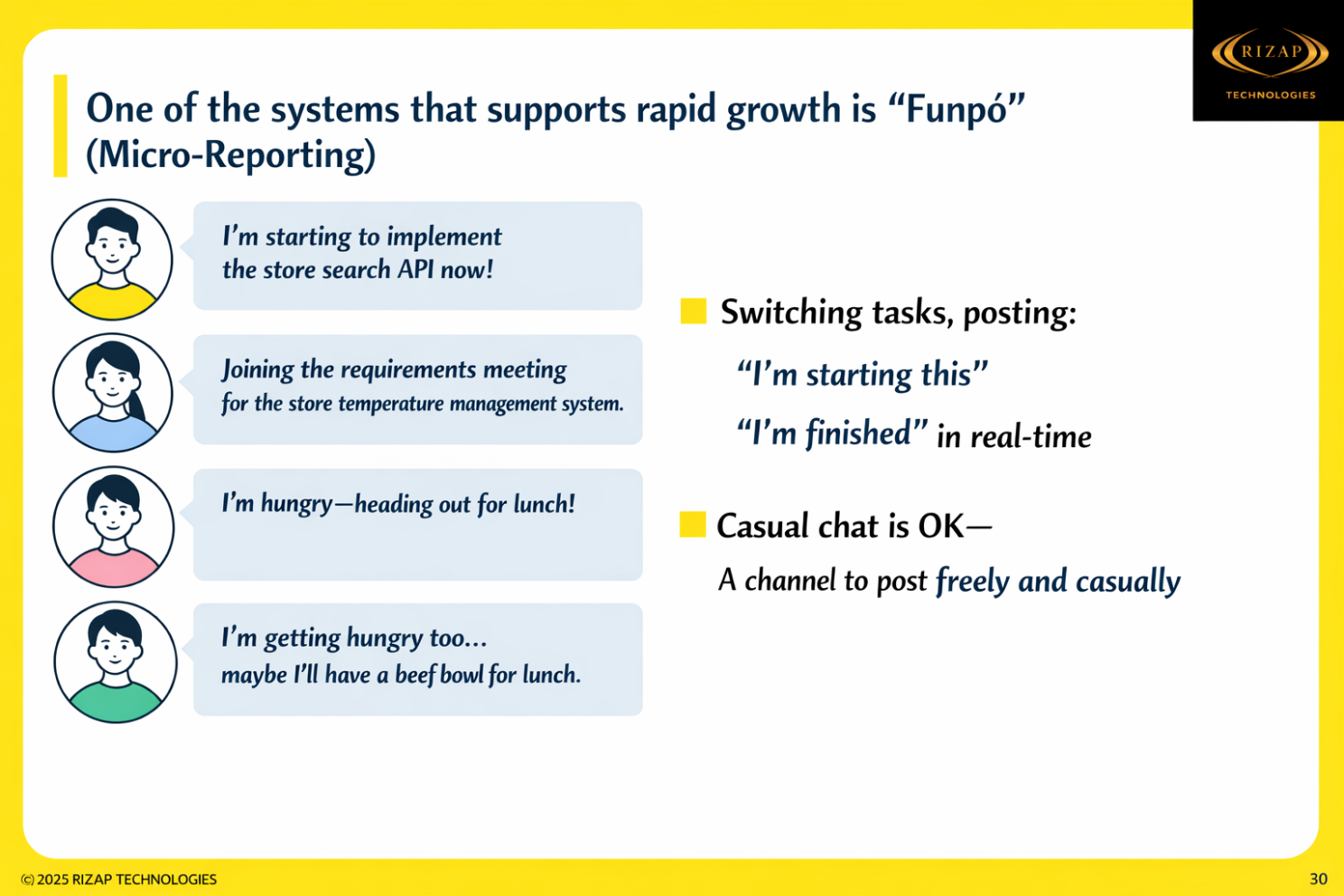
Even though RIZAP is fully remote, they run a system called “分報” — a constant stream of small status messages:
“Starting API work” “Finished tests” “Stuck on authentication” “Going to lunch”
This creates psychological safety and makes it easy to ask for help. No one gets stuck in silence — which is how juniors usually fail.
What this means for Ruby
RIZAP Technologies proved something powerful at RubyWorld Conference and Kaigi on Rails:
Ruby does not need a market full of seniors. It needs organizations that know how to create them.
Rails is not a framework that requires heroes. It is a framework that rewards understanding.
And RIZAP built an entire high-performance Ruby organization by betting on that truth.

 Linking Ruby knowledge from the most remote places in the world.