
April 5, 2026
A new batch of improvements has landed in the Rails codebase this week, focusing on performance refinements, testing reliability, and cleaning up legacy configuration options. Here is what you need to know.
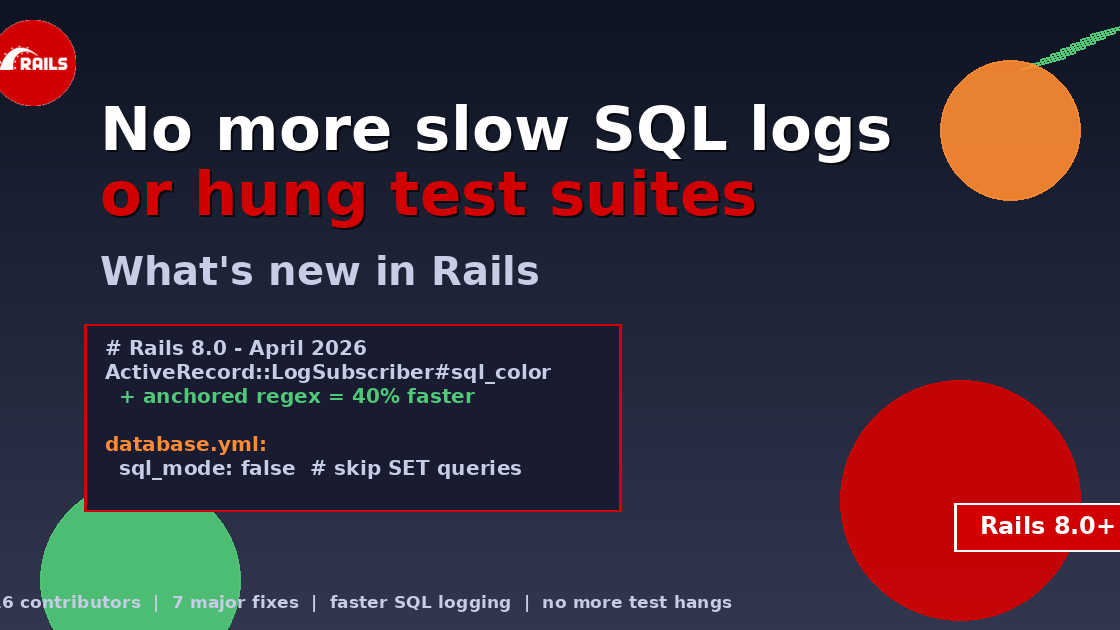
The Headline Change: No More Slow SQL Logs
One of the most impactful fixes this week addresses a timeout issue that could cause extremely long SQL queries to disappear from logs entirely.
The Problem
Rails sets Regexp.timeout = 1 by default as a security measure against ReDoS attacks. When a query containing a massive string (for example, bulk inserts with large text or binary data) passed through ActiveRecord::LogSubscriber#sql_color, the unanchored regex patterns could take several seconds to evaluate.
When this timeout occurred, the query was not logged at all. Instead, developers would see only this error:
Could not log "sql.active_record" event. Regexp::TimeoutError: regexp match timeout
For teams debugging issues involving large payloads, this made it impossible to see what was actually being sent to the database.
The Fix
The solution was simple but effective: anchor the regex patterns used for SQL colorization. By adding anchors to the patterns, evaluation becomes significantly faster even on very long strings, preventing the timeout from being reached.
Why This Matters
If your application handles bulk inserts, large text fields, or binary data in queries, this fix ensures those queries will appear in your logs again. For everyone else, it makes SQL logging slightly faster across the board.
Parallel Test Shutdown Hang: Fixed
The Problem
Rails’ parallel test runner had a frustrating flaw: when a worker process hung during shutdown (stuck in a finalizer, DRb thread, or at_exit hook), the main process would wait forever.
Teams using system tests with Capybara and Cuprite were hitting this intermittently in CI. A watchdog process would eventually kill everything after 90 seconds, but the pipeline would be marked as failed or stalled.
The Fix
A 30-second timeout was added to Parallelization#shutdown. If workers do not exit within that window, they are force-killed with SIGKILL and reaped. This covers both:
- Workers that are alive but unresponsive
- Workers that deregistered but got stuck during exit
Why This Matters
If your CI pipeline occasionally hangs on the test step, this change should resolve it. The timeout is long enough for normal cleanup (teardown hooks, DRb deregistration) but short enough to avoid stalling your builds.
Other Notable Changes This Week
PostgreSQL: Predefined Type OIDs
Rails previously queried pg_type on every new database connection to resolve type OIDs. Since built-in Postgres types have statically allocated OIDs, Rails now ships its own mapping and loads it for free on connect. The query is deferred until an unknown type is actually encountered.
Impact: Faster connection establishment, especially in applications that open many database connections (like Puma with multiple threads or Sidekiq processes).
Validator Condition Merging
A behavioral fix that might affect your models: :if, :unless, and :on conditions are now merged into arrays when specified at both the validator and top level.
Previously, the top-level condition would silently override the per-validator condition:
validates :title, presence: { if: :local? }, if: :global?# Now equivalent to:validates_presence_of :title, if: [:global?, :local?]
Impact: If you rely on the old overriding behavior, you will need to update your code. The new behavior is more intuitive and matches what most developers expect.
Unicode titleize Fix
Inflector#titleize previously used [a-z] in its regex, which skipped Unicode lowercase letters like đ, é, ü, ñ, and ć. It now uses \p{Lower}, fixing capitalization for the full Unicode lowercase category.
Impact: If your application handles internationalized strings and uses titleize, this is a welcome correctness fix.
Skip Individual SET Queries
PostgreSQL and MySQL configure_connection now allow individual SET queries to be skipped by setting them to false in database.yml. This is useful when connecting through a load balancer or proxy that manages session settings itself.
Deprecations to Note
Two deprecated options will produce warnings in upcoming Rails releases:

Update your database.yml files to avoid warnings.
prepend: true for Notification Subscribers
A new prepend: true option on ActiveSupport::Notifications.subscribe ensures a subscriber runs before all others, enabling payload mutation before any downstream handler sees it.
Removed: Ruby 3.2 Time Workaround
Ruby 3.2.0 had a bug where Time.new(…, in: “UTC”) could return an invalid Time object. With the minimum supported Ruby now at 3.3.1, the runtime probe and workaround have been removed.
Fast Path for String Cache Keys
ActiveSupport::Cache now has a fast path for string keys. Since most cache keys are already strings, this short-circuits the #expanded_key normalization, making every cache operation slightly faster.
Full List of Changes
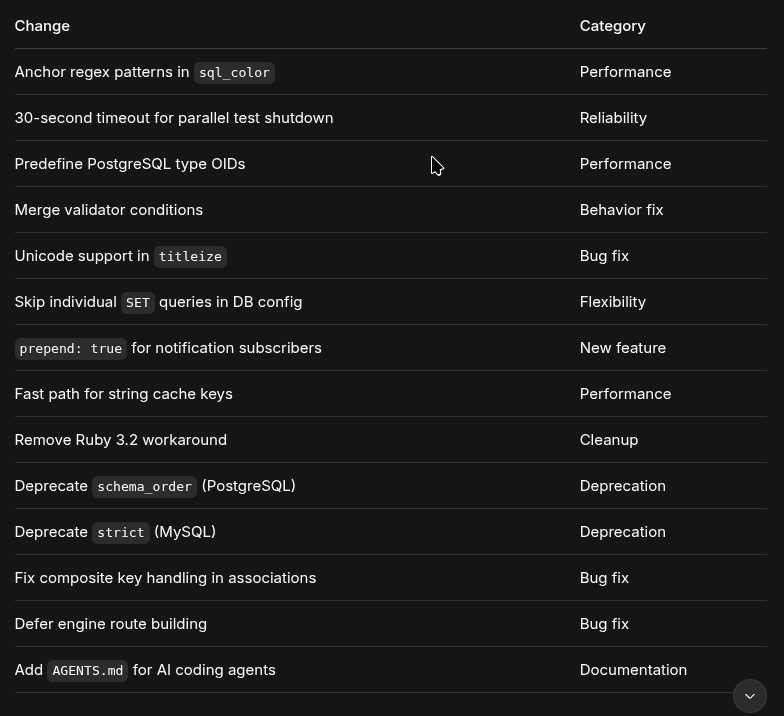
16 contributors made this week’s improvements possible.
Conclusion
This week’s Rails updates tackle real problems that developers encounter in production and CI environments.
The fix for sql_color ensures that even extremely long SQL queries will appear in your logs without timing out. No more dropped queries during debugging sessions. The parallel test shutdown timeout means CI pipelines will no longer hang indefinitely waiting for stuck workers.
Beyond these headline fixes, the deprecations of schema_order and strict give you advance notice to clean up your database.yml files before the next Rails upgrade. The PostgreSQL OID optimization makes connection establishment faster out of the box. The validator condition merging fixes a subtle bug that may have been silently overriding your intended validation logic.
Taken together, these changes represent a steady, practical improvement to the framework. None of them require immediate action from most developers. But when you upgrade, your logs will be more reliable, your tests will finish more consistently, and your configuration will be cleaner.
Upgrade when you are ready. These fixes will be waiting for you.
Originally published on RubyStackNews.com Based on the official “This Week in Rails” summary from April 5, 2026

 Linking Ruby knowledge from the most remote places in the world.