
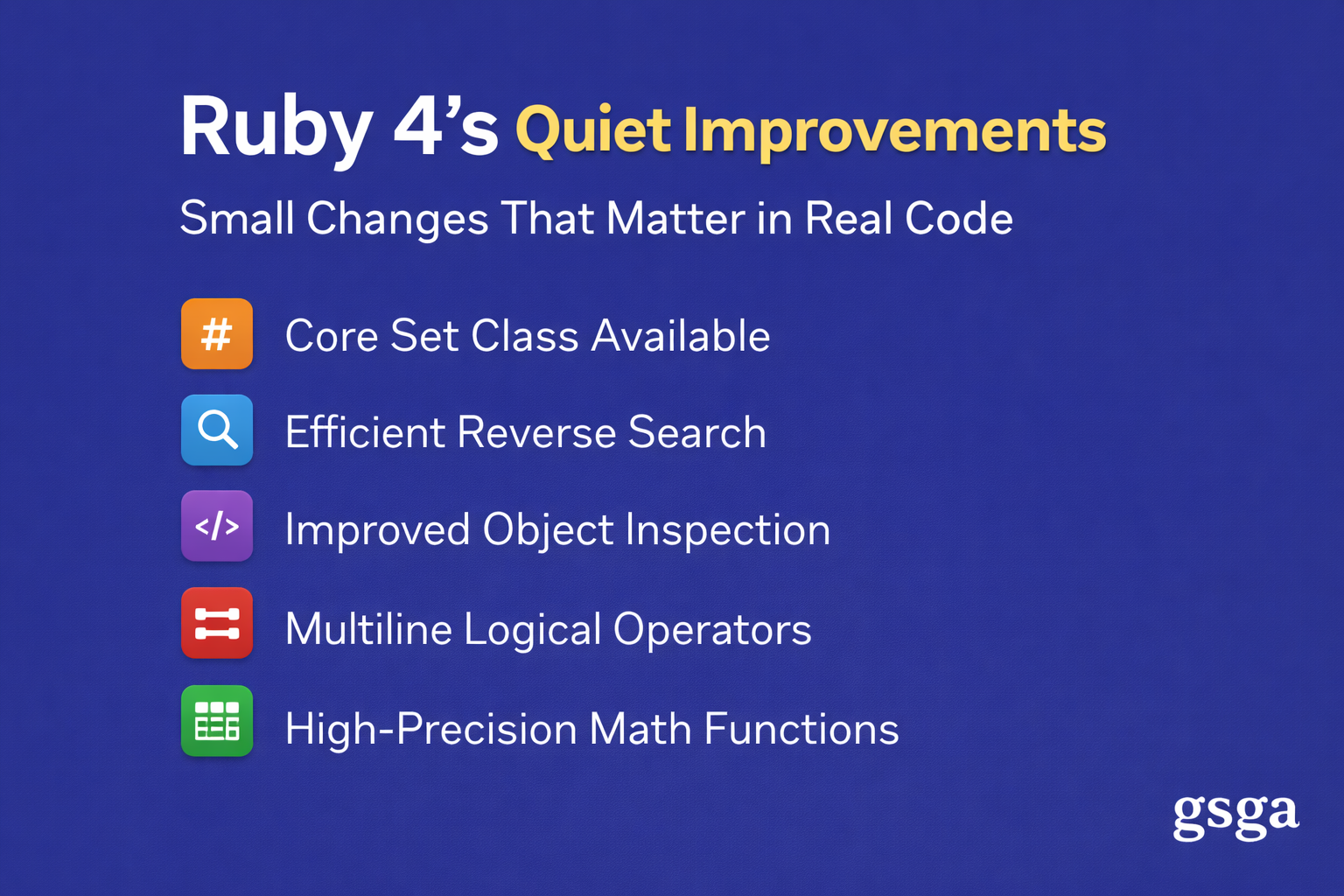
When Ruby 4 was announced, most discussions focused on experimental features like Ractors, new JIT work, or isolation mechanisms. However, beneath the headline features lies a set of quieter improvements — refinements to the core language and standard library that directly affect everyday development.
These changes may not generate conference talks, but they improve performance, clarity, and correctness in real-world applications. This article examines the most relevant of these “silent” upgrades.
📦 Set Becomes a Core Class
One of the most practical changes is that Set is now available without requiring the "set" library.
Previously:
require "set"
Set.new([1, 2, 3])
Ruby 4:
Set[1, 2, 3]
Why This Matters
A Set represents a mathematical collection of unique elements implemented using hashing. It provides near O(1) membership tests and enforces uniqueness by design.
Using an Array where a set is intended is a common performance and correctness issue.
Example — authorization roles:
ALLOWED_ROLES = Set[:admin, :moderator]ALLOWED_ROLES.include?(:admin)
Compared to an array:
[:admin, :moderator].include?(:admin) # linear search
Practical Use Cases
- Authorization systems
- Deduplication pipelines
- In-memory indexes
- Log processing
- Feature flags
- Validation rules
By making Set part of the core language experience, Ruby encourages correct data modeling with minimal friction.
🔎 Array#rfind — Efficient Reverse Search
Ruby 4 introduces Array#rfind, which searches from the end of the array without creating a reversed copy.
Previously:
arr.reverse.find { |x| condition }
This approach allocates a new array and increases memory usage.
Ruby 4:
arr.rfind { |x| x.even? }
Why This Matters
Many real systems care about the most recent matching element — not the first.
Example — log analysis:
last_error = logs.rfind { |entry| entry.level == :error }
Example — job queues:
last_pending = jobs.rfind(&:pending?)
This method avoids unnecessary allocations and improves performance for large collections.
🔍 Controlling Object Inspection Output
Ruby 4 adds a hook allowing objects to control which instance variables appear in inspect.
The Problem
Complex objects often produce noisy or unsafe output:
#<User @id=1 @cache=... @token="secret">
The Solution
class User
  def instance_variables_to_inspect
    [:@id]
  end
end
Output:
#<User @id=1>
Practical Benefits
- Cleaner logs
- Reduced risk of leaking sensitive data
- Better debugging experience
- Improved library usability
For large applications and reusable gems, this change is particularly valuable.
🧠 Multiline Logical Operators
Ruby now supports logical operators at the beginning of continuation lines:
user.admin?
  && user.active?
  && !user.banned?
Why This Matters
Long boolean expressions are common in:
- Authorization policies
- Validation logic
- Query conditions
- Guard clauses
This syntax improves readability without relying on awkward line wrapping.
⚡ Optimized Splat Behavior for nil
The splat operator converts values into arrays:
[*value]
Previously, splatting nil invoked nil.to_a, adding overhead and allowing monkey patches to interfere.
Ruby 4 treats nil as an empty array directly:
[*nil] # => []
Real-World Impact
Flexible APIs often rely on splatting:
def tags=(value)
  @tags = [*value]
end
This optimization reduces allocations and improves performance in dynamic code paths.
⚡ Improvements to Array#find
Although not visible at the API level, Array#find has been optimized internally.
Since this method appears in hot paths across many applications, even small improvements can accumulate into measurable gains in large systems.
🧮 High-Precision Mathematical Functions
Ruby 4 adds numerically stable implementations:
Math.log1p(x)  # log(1 + x)
Math.expm1(x)  # exp(x) - 1
Why These Exist
Direct computation loses precision when x is very small.
These functions are essential in:
- Financial calculations
- Probability models
- Scientific computing
- Machine learning algorithms
🧭 A New Top-Level Ruby Module
Runtime metadata is now grouped under the Ruby module:
Ruby::VERSION
Ruby::ENGINE
Ruby::DESCRIPTION
While a small organizational change, it improves discoverability and consistency.
🧪 Incremental Performance Refinements
Ruby 4 also includes numerous internal optimizations:
- Reduced memory allocations
- Improvements in enumerable performance
- Runtime refinements
- GC tuning
Individually minor, collectively meaningful.
🎯 Conclusion
Ruby 4’s quieter improvements reflect a mature language evolving through refinement rather than disruption. These changes enhance correctness, performance, and developer ergonomics without altering established programming models.
While they may not attract headlines, they directly influence the quality and efficiency of production code.
In practice, such refinements often provide more long-term value than experimental features. They reduce friction, encourage better data structures, and make everyday Ruby programming more predictable and efficient.
Ruby 4 may not demand that developers change how they write software — but it subtly helps them write better software.

 Linking Ruby knowledge from the most remote places in the world.